Posts Tagged ‘Quarry’

Mickey Spillane’s Birthday

Tuesday, March 9th, 2010

Today is Mickey Spillane’s birthday, and after a few announcements, I’m featuring a short piece I did about the first film of I, THE JURY by way of tribute. It appeared in Classic Images last year – Classic Images is a great magazine in newspaper tabloid format that is extremely well-edited by Bob King out of the back of my hometown paper, the Muscatine Journal, where I had my first professional writing job.

Barb’s father, William Mull, passed away yesterday. Bill had been suffering from pancreatic cancer (the killer that took Mickey Spillane out, too, coincidentally). But Bill survived over a year with the disease, which enabled his family to spend time with him in person and on the phone, and say goodbyes properly. He was a fine man with a sly sense of humor, a WW 2 combat vet, a great trumpet player, a successful businessman and the father of seven kids, all of whom grew up just fine. To me, his greatest achievement was helping bring Barbara Mull to the planet.

I am working on ANTIQUES KNOCK-OFF, which already had been dedicated to Bill by his daughter. Barb did an exceptional job on the rough draft. I think this will be the best Brandy and Mother mystery yet, but don’t let that stop you from picking up the current ANTIQUES BIZARRE.

Also, I have already done a series of revisions on QUARRY’S EX – Charles Ardai is the most lightning fast editor on the planet – and that book has been put to bed and is off to the typesetter.

You Can't Stop MeAntiques Bizarre

We got a great review from Bill Crider for YOU CAN’T STOP ME. If you don’t follow Bill’s great blog, start doing so now. He obviously has incredible taste.

Craig Clarke, another great blogger, had wonderful things to say about ANTIQUES BIZARRE.

The Court Reporter website recently posted a very controversial list of the top 100 crime novels of all time. I mention this because (oddly, it seems to me) I am represented on that list for…ready for this?…my novelization of AMERICAN GANGSTER. Now I’m proud of that book, and it made the NY Times bestseller list, and won the Scribe from the International Association of Media Tie-in Writers. But of everything I’ve ever written (say, TRUE DETECTIVE or ROAD TO PERDITION or THE FIRST QUARRY)…why that? But I’ll take it, since my policy is that any such list is utter bullshit…unless I’m on it.

And now, in honor of Mickey’s birthday….

I, THE JURY – NOIR IN 3-D
by Max Allan Collins

I, The Jury 3DMickey Spillane was not a fan of the films British producer Victor Saville fashioned in the 1950s from the mystery writer’s bestsellers, I, the Jury, The Long Wait, Kiss Me Deadly and My Gun Is Quick. So incensed by what he considered a mishandling of his famous private eye, Mike Hammer, Spillane wrote and co-produced THE GIRL HUNTERS (1963) in which he starred as Hammer himself.

Time has been kind to several of the Saville films, notably KISS ME DEADLY (1955), starring Ralph Meeker, directed by Robert Aldrich and written by A.I. Bezzerides. The film had a strong anti-Spillane subtext but was nonetheless a brilliant evocation of Mike Hammer’s violent, sexually charged world. Late in life, Spillane came to appreciate KISS ME DEADLY, which is now considered a noir classic; but he never warmed to the others. With MY GUN IS QUICK (1957), wherein Robert Bray portrayed Hammer, Spillane had a point: it was a slipshod quickie. THE LONG WAIT (1954) (with Anthony Quinn as a non-Hammer protagonist and an array of beauties including Peggie Castle) does have its admirers, with a particularly strong climax involving starkly expressionistic lighting.

Though he counted Biff Elliot a friend, Spillane disliked I, THE JURY (1953). He thought Elliot was too small, though his chief complaints were with the script and such details as Mike Hammer’s trademark .45 automatic being traded in for a revolver, and he howled about Hammer getting knocked out with a coathanger. He found director/screenwriter Harry Essex obnoxious and disrespectful, and was irritated that his handpicked Mike Hammer – close friend, ex-cop Jack Stang (for whom the hero of the posthumous novel Dead Street is named, and who appears briefly in I, THE JURY in a poolroom scene) – was turned down for the part.

In 1999, Mickey and I were invited to London where the National Film Theater was showing my documentary, “Mike Hammer’s Mickey Spillane,” as part of a retrospective of Spillane films. Mickey did not bother to attend any of the screenings except my documentary. But I was eager to attend a rare 3-D screening of I, THE JURY.

I’d always liked the film, and had argued its merits (and those of KISS ME DEADLY) to Mickey over the years. Of all the Saville films, I, THE JURY seemed to catch best the look and flavor of the novels; it was fun and tough and sexy, and the dialogue had crackle. What had disappointed moviegoers at the time remains disappointing: the most overtly sexual aspects of the plot (a dance studio may or may not be a brothel, several characters may or may not be homosexual) became incoherent due to censorship issues, and the famous striptease finale reduced lovely Peggie Castle’s disrobing to taking off her shoes!

But Elliot himself was a terrific Mike Hammer – an emotional hothead who could be as tough as he was tender. That he was a little smaller than readers might have imagined Hammer only makes him seem less a bully. He fights hard and loves hard, and may not be as smart as most movie private eyes, which gives him a nice everyman quality. It’s a shame Elliot, with a screen presence similar to James Caan’s, was not better launched by the film.

The revelation of the screening, however, was the 3-D cinematography – seen “flat” on TV, the film doesn’t seem to be much of a 3-D movie, with only a few instances of objects and people coming out of the screen. But the 3-D screening revealed the brilliant John Alton’s mastery at creating depth, bringing the viewer inside the images. As one of a small handful of 3-D crime films, I, THE JURY is an unacknowledged 3-D gem.

More on Collaboration and Reviews

Tuesday, March 2nd, 2010

You Can't Stop MeThis is a big week for us, with ANTIQUES BIZARRE and YOU CAN’T STOP ME going on sale everywhere. Hard to imagine two more different books, but I’m starting to hear from fans who are into both the cozy-ish if wacky mysteries about Brandy and her eccentric mother, and my more noir-ish stuff, like YOU CAN’T STOP ME, Nate Heller and Quarry.

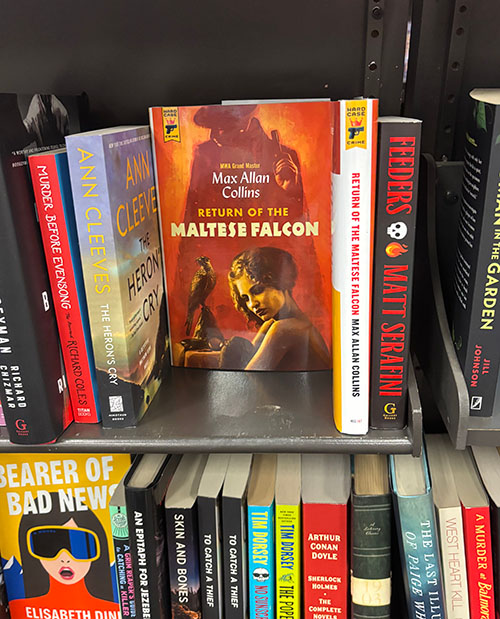
Speaking of Quarry, over the weekend I delivered the new Quarry novel, QUARRY’S EX. It will be out this fall from Hard Case Crime. And yes, we do actually meet Quarry’s ex-wife, the woman whose faithlessness sent our anti-hero into the tailspin of professional killing. It has an indie movie set setting, and takes place in 1980. I have now done four Quarry novels for editor Charles Ardai – tying the four written back in the mid-‘70s for editor Patrick O’Connor at Berkley Books. There is serious talk of the first four novels coming out in uniform trade editions from a small publisher.

And I am sorry to inform Heller fans that the new Nate Heller novel, BYE BYE, BABY, will not appear until June 2011. I have done everything I can to ask the editor to move it up the list, but publishing moves in mysterious ways.

Last week, Barb wrote a very well-received column here about our collaboration as “Barbara Allan.” This week, Matt Clemens discusses collaborating with me at my pal Ed Gorman’s great blog.

Here’s a really fun QUARRY IN THE MIDDLE review that explores the RED HARVEST connection.

Publisher’s Weekly has reviewed the audio novel THE LITTLE DEATH and gives it a rave.

But PW also gave THE BIG BANG a less good review (presumably a different reviewer – and I’m not providing a link for this) which indicates how much of a crap shoot even the bigtime reviews are. This reviewer complained that the book would appeal only to Mike Hammer and Mickey Spillane fans (who else was it supposed to appeal to?) and complained that it didn’t read like one of my Nate Heller books (should my Nate Heller books read like Mike Hammer?). Dumb. In the same PW issue, though, a presumably different reviewer seems to like Hammer and his appearance in a forthcoming MWA anthology, CRIMES BY MOONLIGHT: MYSTERIES FROM THE DARK SIDE, saying:

“Mike Hammer gets into X-Files mode in Max Allan Collins’s and Mickey Spillane’s ‘Grave Matter,’ which successfully introduces a supernatural element into the case of a series of mysterious deaths in the ironically named town of Hopeful, N.Y.”

Meanwhile, the first Spillane/Collins Mike Hammer outing, THE GOLIATH BONE, is still getting positive reviews, including this fun one from a blogger.

Here’s an insightful review of the collection MEAN STREETS, which includes the Nate Heller story, “House Call.”

And, yup, THE LAST LULLABY keeps getting great notices, as on this blog.

Finally, courtesy of Nate Collins who saw it, ROAD TO PERDITION has been listed as one of the 75 must read’s in DC Comics’ 75 years of publishing. That will be 76, when RETURN TO PERDITION comes out!

M.A.C.

Barbara Collins on Barbara Allan

Tuesday, February 23rd, 2010

This week I’m turning the update over to Barb, in celebration of ANTIQUES BIZARRE going on sale this week (the pub date isn’t till March 1 but on sale date seems to be Feb. 23).

Before I do, though, we have had a lovely review of the book that you might like to check out.

Also, Quarry continues to attract attention – for example, this fun review of THE FIRST QUARRY.

In addition, here’s a retro review of the Quarry novel PRIMARY TARGET. PRIMARY TARGET is available as the bulk of QUARRY’S GREATEST HITS from FiveStar.

And now the better (and better-looking half) of the Barbara Allan team, on collaboration – a piece that expands and updates a piece she wrote for CRIMESPREE a while back. She refers to me as “Al,” which many of you know is my nickname.

Antiques BizarreAntiques Bizarre, the fifth book in our Trash ‘n’ Treasures mystery series from Kensington, will be hitting the stores this week. This latest collaboration between Al and me, under the name Barbara Allan, is more of a who done-it than the previous books, but there is still plenty of turmoil in the personal lives of Prozac-popping Brandy Borne, bi-polar Mother, and their blind, diabetic dog Sushi. The mystery revolves around the auction of the newly discovered last Faberge egg that had been commissioned by the Russian Tsar, its disappearance and the death of the buyer.

Often Al and I are asked about collaboration. Why do it? Why risk a friendship, a business association, or (gasp) even a marriage?

Collaboration happens successfully in movies, of course, when the collective efforts of writer, director, and actors come together to make something wonderful – Road to Perdition comes to mind. And collaboration works beautifully in musical theater, too. Where would Rodgers be without Hammerstein? Or a certain composer named Bernstein without the brilliance of a young lyricist named Sondheim? But can the joining of two minds and one computer work as well in novel writing? Quick, name your favorite book written by a duo. Hummmmm…me neither.

My own experience with collaboration came after I’d published a number of short stories, and my next assignment left me with unhappy results.

“What’s wrong with it?” I asked my veteran writer-husband after pressing the pages I had just written into his hands, as if it were a patient in need of resuscitation.

“It’s missing a key scene,” he said a while later, adding, “You got lazy.”

“Awwh, I don’t wanna write it,” I whined. “Will you?”

“Sure…but then my name goes on it, too.”

Well, that seemed reasonable; after all, writing a key scene was much more of a contribution than plot suggestions given to me over breakfast at Country Kitchen, or suggestions jotted in the margins of my work. And so, my first foray into the tricky world of collaboration was quite, quite painless.

Barbara AllanSince then, Al and I have collaborated on other short stories, two stand-alone novels, and – having confidence that the marriage would hold – signed a five-book contract. Our Trash ‘n’ Treasures mysteries – the first of which, Antiques Roadkill, came out from Kensington in fall of ‘06 – have a female voice, with back story that leans more on my life than Al’s, although the antiquing aspect is a shared interest.

Our collaboration process is simple: we plot the novel together, often on a long car trip or over several restaurant meals; usually I take notes. Then I write a complete first draft without Al seeing any of it. If I run into trouble along the way, we discuss the problem over another lunch (there’s a very famous restaurant in Muscatine, Iowa – perhaps you’ve heard of it: Applebees).

Then, when I’m finished with the first draft (and good and sick of it), Al takes his pass, bumping up the word count because I’m a short story writer at heart, and he can flesh out scenes and descriptions, in particular amplifying dialogue. He also fixes any plot holes or too-girly fight scenes.

During this phase there can be some shouting – but only because Al’s office is on the second floor and mine is on the first, and we haven’t sprung for an intercom system yet – as he asks, “What did you mean by this?” or “How about doing it this way?” As Al revises each chapter, I read his second draft for corrections and any final additions or changes I’d like to lobby for. The end product, then, is something we both feel satisfied with.

So. For those of you who dare to follow in our footsteps, here are a few observations and suggestions we’ve learned along the way.

Do not attempt to collaborate if you and your partner have incompatible writing styles. Exception: one person does the research; the other writes. (The great team of Dannay and Lee behind Ellery Queen divided up the work in a fashion that didn’t require compatible styles of expression.)

Maintain separate offices and computers. One person seated at a desk while the other stalks the floor smoking a stogie only worked on “The Dick Van Dyke Show.” Ditto for sitting side by side.

Before writing a word, have a clear and singular vision of what the writing project is to be. This is more than just plotting, but attitude and even thematic concerns. Before beginning our novel Regeneration, we discussed at length the notion of the selfishness of baby boomers, and how they had failed to properly save for retirement.

Think of the collaboration as two builders teaming to construct a house: one writer takes the lead and fashions the structure (to specifications already agreed upon); the other writer then takes over and decorates the interior. The interior decorator should not go knocking out supporting walls; conversely the original builder should not re-arrange the furniture, at least without discussion.

Those who think collaboration is somehow a time-saving approach are, well, confused. It is actually harder – although if each writer has a sense of his or her strengths and weaknesses, that’s a great help. If writer A and B agree that A is better at dialogue, for example, writer B can write short dialogue scenes knowing that writer A will come along later and effectively expand.

Sometimes it comes down to sheer knowledge – I don’t think I’ll be handing over the fashion do’s and don’ts, or even the antiquing tips, to Al any time soon. But why should I break my back writing a fight scene with the creator of Nathan Heller in the house?

Beyond shoring up each others weaknesses through your own strengths, why should a writer embark on such a perilous enterprise? The answer is as simple as collaboration is complex: a third writer is created.

A successful writing collaboration creates a distinct third voice in an end product that – because of the strengths each writer brings to the work table – could not have been accomplished alone.

That’s when two plus two can equal five. Even my husband can do that math.

The Maltin Falcon

Tuesday, February 16th, 2010

I’ve posted a number of links lately to reviews of THE BIG BANG, YOU CAN’T STOP ME and ANTIQUES BIZARRE, as well as older books of mine. But this week I’m happy to report that some nice write-ups appear in current issues of bigtime national newstand magazines. You know – the kind you can hold in your hand and turn the pages.

Antiques BizarreANTIQUES BIZARRE – due out next week – received a splendid four-star review in the March 2010 RT BOOK REVIEWS (RT standing for ROMANTIC TIMES). The magazine always leads off with a review followed by a spoiler-free plot summary. Among other things, RT describes the novel as “a cozy with a twist” and “hysterically funny as well as a solid mystery.” An insightful comment notes that our protagonist Brandy “has an unusually realistic life in all its messiness.”

Jon Breen leads off his Jury Box column in the March/April ELLERY QUEEN MYSTERY MAGAZINE with high praise for Hard Case Crime, singling out three books for excellent three-star reviews (Jon does not bestow 1/2 stars, a three-star review is second only to a four-star one in the Jury Box). He describes yours truly as “one of the best and most prolific and versatile crime writers currently practicing,” and QUARRY IN THE MIDDLE as a “most welcome 1980’s flashback,” and wraps up saying, “Neat plot, fine style, fast reading.” Jon – just about the best scholar in best mystery fiction, and a fine mystery novelist in his own right/write – has been a supporter of my work for decades, and to whatever degree I have a respectable reputation, he has played a major role. The first review I ever received in a national magazine was from Jon in EQMM…for one of the early Quarry novels.

And I know you will want to read the March PLAYBOY for its articles – particularly one small, snazzy one. PLAYBOY gives the forthcoming THE BIG BANG a solid write-up under the heading KILLER FICTION – HAMMER LIVES, including a full-color shot of the ‘60s pop-art front cover of the novel. Among other nice things, the review/mini-article says, “Max Allan Collins, Spillane’s collaborator and author of Road to Perdition, has expertly completed a second Spillane novel, The Big Bang, out this spring. The book will transport you back to gritty 1960s Manhattan, where Spillane’s antihero Mike Hammer drops acid and takes on the mob.” What a thrill to get such great coverage from the very magazine I used to steal out of the mailbox before my father knew it had arrived.

There are few movie reviewers that I admire or trust, but Leonard Maltin is one of them. Time for one of those “full disclosure” things: we are friends. We became friends after I did a DICK TRACY movie interview for him and ENTERTAINMENT TONIGHT back in 1990 – he called me up and dubbed me, “Mr. Sound Bite.” Our mutual obsessive love for movies, particularly of the ‘30s, ‘40s and ‘50s, fed a wonderful friendship. Yes, he has given me occasional good reviews, but he doesn’t always like what I do (he was a fan of MOMMY, for example, but didn’t think much of MOMMY’S DAY). I find myself agreeing with him more often than not, and you can follow his reviews and pop culture commentary at Leonard Maltin’s Movie Crazy.

He is also, of course, the author of the annual, indispensable LEONARD MALTIN’S MOVIE GUIDE. Five years ago, he was forced to publish a second book to include the older movies that time and space had shoved out of his regular guide – LEONARD MALTIN’S CLASSIC MOVIE GUIDE. For those of us who live by Turner Classic Movies and who spend way too much money at Warner’s Archive (at www.WBshop.com), this book is similarly indispensable. The second edition of this has just come out. If you love movies, you need both of these books stacked in a handy place in your home theater (in my case, next to my recliner in the living room).

151 Best Movies You've Never SeenAt the same time, a book that I would rank with Leonard’s best has also been published: 151 BEST MOVIES YOU’VE NEVER SEEN. I am a movie buff, pretty hardcore, but I had heard of only about half of these, and had seen only around 25. These are short – page and a half – chatty reviews in Leonard’s deceptively easygoing style, personal without being obnoxious, informative without being pedantic, one of those books that go down in wonderful handfuls, like popcorn. Most of the films are of fairly recent vintage – last ten years or so – and perhaps a third are foreign; one of the surprises is how few Golden Age era films Leonard discusses.

But one of the vintage movies he praises really made me smile – the much-maligned 1931 version of THE MALTESE FALCON. He does not make a case for it being superior to the 1941 John Huston/Bogart classic – even I wouldn’t do that – but he does sing its praises in a manner that makes you want to drop everything and watch it right now. That’s true of every essay in the book, and you – like me – will likely make a list of movies you want to find on DVD or on cable, as soon as you have finished this great book.

Musical note: Crusin’ had a capacity crowd for the Valentine’s Day dinner dance at Piazza Bella. Lovely evening. For those concerned, please know that we did not play “Pussy Whipped.”

M.A.C.