Posts Tagged ‘Spillane’

Mickey Spillane and Sherlock Holmes!

Tuesday, May 19th, 2026

This week I want to alert you to two volumes that should be of interest to anyone who’s dropped by here. I have emphasized Return of the Maltese Falcon, True Noir, Death by Fruitcake and a few other things of mine in recent weeks (months?) and a few pertinent publications have been wrongfully ignored here.

First:

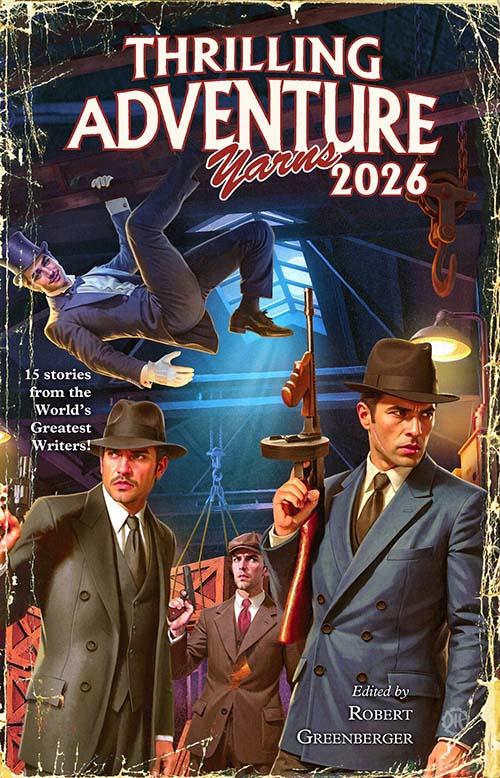
Thrilling Adventure Yarns 2026 cover
Thrilling Adventure Yarns 2026
Publisher: Crazy 8 Press

In each volume, Crazy 8 Press continues to honor the Golden Age of pulp storytelling, which proved formative and inspirational to generations of authors. Now, in this fifth volume, we explore new worlds, revisit old friends, and provide more pulse-pounding, two-fisted exploits for your reading pleasure

Returning authors include Derke Tyler Attico, Russ Colchamiro, Keith R.A. DeCandido, Mary Fan, Michael Jan Friedman, Robert Greenberger, Paul Kupperberg, Aaron Rosenberg, Hildy Silverman, and Will Murray.

Making their debut in this volume are Christopher D. Abbott, Beth Cato, Max Allan Collins & Matthew V. Clemens, Esther Freisner, Alisa Kwitney, JM DeMatteis, and Steven Grant.

Fans of recurring characters will be delighted: Sherlock Holmes, Ticonderoga Beck, Sword & Sorcery, Birr Blackjaw and friends, and Max Wiser are all included. Additionally, there are new adventurers and sleuths to meet within these pages, plus a brand-new Lupin tale.

The Kindle edition is available for pre-order here. My understanding is that a physical media (you know – book) version will also be available. I’ll keep you posted.

The story Matt Clemens and I wrote was the second of two Holmes yarns we did for a jigsaw puzzle company, who paid us but dropped the program before the second story was published. We heavily rewrote it, but that’s where it began.

* * *

This is available right now:

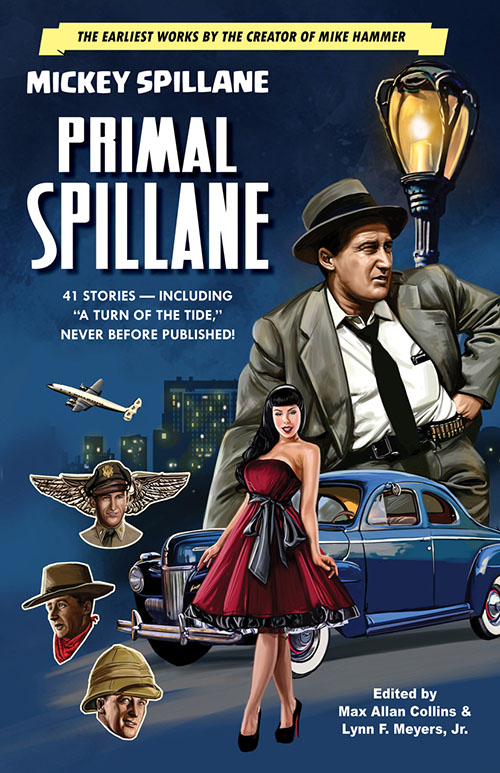
Primal Spillane (Bold Venture edition)
Primal Spillane: Early Stories 1941 – 1942
by Mickey Spillane
Edited by Max Allan Collins & Lynn F. Myers, Jr.
Cover by Martin Baines

41 fast-moving short-short stories by the creator of Mike Hammer! Revised and expanded with fourteen new stories, including “A Turn of the Tide,” a previously unpublished tale.

Before Mike Hammer, P.I. made his explosive debut in I, the Jury, author Mickey Spillane (1918-2006) toiled in relative obscurity, writing short-short stories as filler material in Golden Age comic books. Their purpose to fulfill a postal requirement, these stories were the literary boot-camp for the future king of hardboiled fiction.

In commemoration of the Spillane centenary, Bold Venture Press released the newly revised and expanded edition of Primal Spillane: Early Stories 1941 – 1942. This unique anthology, long out-of-print and largely unavailable, contains additional material never before reprinted — and a newly discovered, previously unpublished story by Spillane.

In this collection, you’ll meet high-flying soldiers, a prospector exploring a Lovecraftian mine-shaft, a light-fingered con artist, an overworked cub reporter, a hapless exterminator, and many others.

Readers have the opportunity to see a master develop his craft. Primal Spillane collects the earliest short stories bylined Mickey Spillane — Each story moves fast, and concludes with the trademark Spillane “socko finish.”

Today’s combined cost of the rare comic books in which these text pieces first appeared would be more than that of a new Cadillac; but these short stories provide their own memorable rides. Their value as a training ground for the 20th Century’s top crime-fiction writer is priceless when compared to the millions of fans across the world entertained by Mickey Spillane’s prose.

Introduction by Max Allan Collins and Lynn F. Myers, Jr.

Get it here in trade paperback and e-book:

Directly from Bold Venture Press.

Or from Amazon.

Bold Venture also offers a hardcover version.

* * *
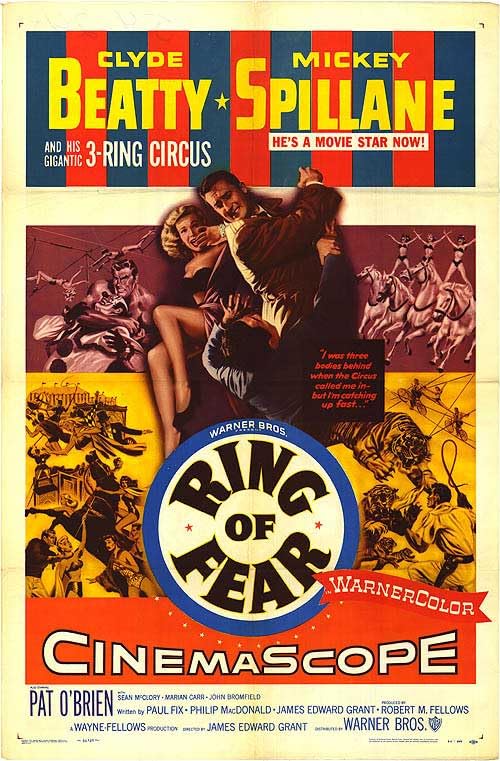
Ring of Fear (1954) poster

My buddy Heath Holland and I did a commentary for the Mickey Spillane-starring 1954 film Ring of Fear. That film, in glorious color and cinemascope, is included in the latest Essential Film Noir Collection (Vol.6) from Australia’s Imprint label. Here’s a great review (scroll down).

Now Imprint’s releases play just fine in American Blu-ray players. This is a beautiful if pricey (about a hundred bucks for four Blu-rays) boxed set, available from my friends at the reliable Diabolik.

This is an interesting Den of Geek take on the Dick Tracy movie. Pretty smart.

For those of you who wonder why I stayed in Muscatine, Iowa (frankly, sometimes that group includes Barb and me), here’s a nice look at the town. I like this, because it’s a rare time I’m listed fairly prominently with Mark Twain.

M.A.C.

An Irish-American Legend: Mickey Spillane

Tuesday, March 18th, 2025

I am in the midst of a project (the nature of which I’ll share here soon), so this will be a short update, at least on the news side.

It’s St. Patrick’s Day 2025 as I write this, and how better to celebrate that (sort of) holiday than to share with you this nice article on Mickey Spillane from Casa Carlini. I rate a single mention – not exactly accurate – but that doesn’t take away from what a nice piece this is…even I do wish there’d been mention of the current Baby, It’s Murder, the final Hammer novel of the fifteen books I’ve fashioned from partial manuscripts and synopses entrusted to me by Mickey himself in his final days.

Mickey Spillane in 2001
Hard-Boiled and Unforgettable:
The Legacy of Mickey Spillane

Mickey Spillane, the literary titan of hard-boiled crime fiction, left an indelible mark on the world of detective stories. His name is synonymous with gritty narratives, tough-as-nails protagonists, and a writing style that punches you in the gut. But Spillane’s legacy is more than just a collection of thrilling tales—it’s a testament to the enduring appeal of raw, unfiltered storytelling. In this deep dive, we’ll explore the man behind the typewriter, the cultural impact of his work, and why his stories continue to captivate readers decades later.

The Man Behind the Mike Hammer Mysteries

Mickey Spillane, born Frank Morrison Spillane in 1918, was a man who lived as boldly as the characters he created. Before he became a literary sensation, Spillane dabbled in various careers, including as a circus performer and a fighter pilot trainee during World War II. But it was his foray into writing that cemented his place in history.

Spillane’s breakout character, Mike Hammer, debuted in I, the Jury (1947), a novel that set the tone for his signature style. Hammer wasn’t your typical detective—he was a vengeful, no-nonsense antihero who operated by his own moral code. Spillane’s writing was fast-paced, visceral, and unapologetically violent, a stark contrast to the more polished detective fiction of the time.

The Hard-Boiled Revolution

Spillane didn’t just write crime novels; he revolutionized the genre. His work was a departure from the cerebral whodunits of Agatha Christie or the suave sophistication of Raymond Chandler’s Philip Marlowe. Instead, Spillane’s stories were raw, emotional, and often controversial. He didn’t shy away from depicting the darker side of human nature, and his protagonists were flawed, complex, and deeply relatable.

The term “hard-boiled” perfectly encapsulates Spillane’s approach. His stories were tough, gritty, and unflinching, much like the detectives who populated them. Mike Hammer wasn’t just solving crimes—he was navigating a world of corruption, betrayal, and moral ambiguity. This realism resonated with readers, making Spillane one of the best-selling authors of the 20th century.

Controversy and Criticism: Love Him or Hate Him

Spillane’s work wasn’t without its detractors. Critics often dismissed his novels as overly violent, misogynistic, or sensationalistic. Some accused him of prioritizing shock value over literary merit. But Spillane didn’t care. He famously quipped, “I don’t have fans. I have customers.” His focus was on entertaining his readers, not winning over the literary elite.

Despite the criticism, Spillane’s influence on the crime fiction genre is undeniable. His work paved the way for later authors like Elmore Leonard, James Ellroy, and even modern-day thriller writers. He proved that crime fiction could be both commercially successful and culturally significant.

Mike Hammer: The Antihero We Can’t Forget

At the heart of Spillane’s success was Mike Hammer, the quintessential hard-boiled detective. Hammer was a man of contradictions—brutal yet compassionate, cynical yet idealistic. He wasn’t afraid to bend the rules (or break them) to achieve justice, and his relentless pursuit of the truth made him a compelling character.

Hammer’s popularity extended beyond the pages of Spillane’s novels. He became a cultural icon, appearing in films, television shows, and comic strips. Actors like Darren McGavin and Stacy Keach brought Hammer to life on screen, each adding their own interpretation to the character. Even today, Mike Hammer remains a symbol of the hard-boiled detective archetype.

Spillane’s Writing Style: Punchy, Provocative, and Unforgettable

One of the hallmarks of Spillane’s writing was his ability to grab readers from the very first sentence. His openings were often explosive, setting the tone for the rest of the story. For example, the first line of I, the Jury is iconic: “I shook hands with the man whose brother I’d killed.” It’s a masterclass in hooking the reader and establishing the stakes.

Spillane’s prose was lean and mean, with no room for unnecessary flourishes. He had a knack for dialogue that crackled with tension and descriptions that painted vivid pictures with just a few words. This economy of language made his stories fast-paced and immersive, keeping readers on the edge of their seats.

The Cultural Impact of Mickey Spillane

Spillane’s influence extends far beyond the world of literature. His work helped shape the cultural landscape of mid-20th century America, reflecting the anxieties and complexities of the post-war era. The themes of his novels—corruption, justice, and the struggle between good and evil—resonated with a society grappling with rapid change.

Moreover, Spillane’s success demonstrated the power of genre fiction. At a time when literary snobbery often dismissed popular fiction as inferior, Spillane proved that genre writing could be both commercially viable and artistically significant. His legacy paved the way for future generations of genre authors to be taken seriously.

Spillane’s Later Years and Enduring Legacy

Even in his later years, Spillane remained a prolific writer. He continued to produce novels, short stories, and even comic books, proving that his creative spark never dimmed. In the 1990s, he collaborated with Max Allan Collins to complete several unfinished manuscripts, ensuring that his work would continue to reach new audiences.

NOTE FROM M.A.C.: Mickey and I did projects during his later years, from the Mike Danger comic book to numerous co-edited anthologies. The unfinished manuscripts were addressed after his passing, and represent posthumous works with considerable Spillane content.

Spillane passed away in 2006, but his legacy lives on. His novels are still widely read, and his influence can be seen in everything from modern crime fiction to film and television. The hard-boiled detective archetype he helped popularize remains a staple of popular culture, a testament to the enduring power of his storytelling.

Why Mickey Spillane Still Matters Today
In an age of complex antiheroes and morally ambiguous narratives, Mickey Spillane’s work feels more relevant than ever. His stories remind us that the line between right and wrong isn’t always clear, and that justice often comes at a cost. Mike Hammer may not be a traditional hero, but his unwavering commitment to his own code of ethics makes him a compelling figure.

Spillane’s writing also serves as a reminder of the power of storytelling. In a world saturated with content, his novels stand out for their raw emotion, gripping plots, and unforgettable characters. They remind us why we fell in live with crime fiction in the first place.

A Hard-Boiled Legend
Mickey Spillane was more than just a writer—he was a cultural force. His work redefined the crime fiction genre, introduced us to one of literature’s most iconic detectives, and proved that storytelling doesn’t need to be polished to be powerful. Whether you love him or hate him, there’s no denying the impact of Mickey Spillane.

So, the next time you pick up a gritty crime novel or watch a noir film, take a moment to appreciate the man who helped make it all possible. Mickey Spillane may have been hard-boiled, but his legacy is anything but forgettable.

* * *

J. Kingston Pierce at the indispensable Rap Sheet recommends Baby, It’s Murder as one of the most interesting of recent mystery novels. He also provides a link to Borg’s splendid review of the book, if you missed it.

A very good look at Road to Perdition (primarily the film version) is here.

* * *
True Noir banner

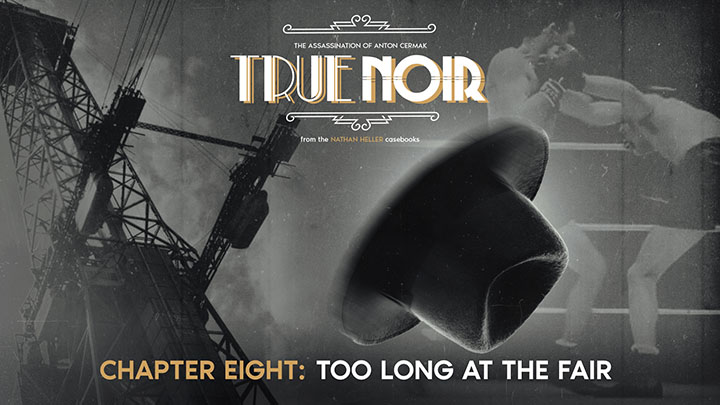
Director Robert Meyer Burnett’s eighth episode of True Noir: The Assassination of Mayor Cermak has just dropped, and it’s a banger, as Rob himself might say. Probably the most impressive episode in terms of sound design if nothing else. And we’re in the home stretch now! Two episodes to go….

M.A.C.

Cancellation, Liquidation & Other Heart-Stopping Adventures

Tuesday, August 16th, 2022

Barb and I have had to cancel our Bouchercon registration and we are sad and sorry we won’t be seeing any of our friends and fans who might be in Minneapolis in a few weeks. The reason for this is discussed below, but I wanted to get the word out right now that we won’t be there (we’d been scheduled for several panels).

We’ve had our first review for the upcoming (Oct. 4) Antiques Liquidation. It’s from Publisher’s Weekly, and it’s a good one. Here it is:

Antiques Liquidation

Antiques Liquidation
Barbara Allan. Severn, $29.99 (208p) ISBN 978-0-7278-5091-1

At the start of Allan’s madcap 16th Trash ’n’ Treasures mystery (after 2021’s Antiques Carry On), flamboyant septuagenarian Vivian Borne – honorary deputy sheriff of Serenity, Iowa, antiques dealer, and magnet for murder – awakens her long-suffering 33-year-old daughter, Brandy, at 2 a.m. for a questionable meeting early that same morning with sleazy auctioneer Conrad Norris to purchase dead stock (aka “old unused new merchandise”) for their shop. Vivian blithely ignores the dangers of entering a decrepit warehouse once owned by Lyle “the Liquidator” Dayton, who mysteriously disappeared years earlier. Vivian uses some dirt she has on Norris to blackmail him into letting her cherry-pick from the stock before he auctions it. When Norris ends up dead atop an elevator after the auction, Vivian is determined to solve the case. With a reluctant Brandy and her fiancé, Tony Cassato, Serenity’s chief of police, Vivian investigates a lengthy list of suspects with reason to kill the double-dealing auctioneer. Can Vivian and Brandy expose the murderer before he permanently liquidates them? Humorous asides and loads of antique lore will please series fans. Allan (the pen name of Barbara Collins and Max Allan Collins) delivers the cozy goods. Agent: Dominick Abel, Dominick Abel Literary. (Oct.)

In addition to this being a nice review, it’s nice to be reviewed at all with an entry in a long-running series. Reviews no longer come automatically from the trades (Publisher’s Weekly, Kirkus, Library Journal, Booklist) for the long-running Mike Hammer and Quarry novels, and we feel lucky for the attention.

In our local area, the news about Gary Sandy coming to town to star as Mike Hammer in a radio-style production of Encore for Murder has hit local media. Check it out.

In the meantime I have been working with my old pal Phil Dingeldein on other 75th Anniversary of Mike Hammer matters, specifically recording and editing a wraparound for the restored 1954 Brian Keith TV pilot that will be part of the ClassicFlix release of the 1953 version of I, the Jury. As I’ve mentioned here before, that release will really be something special – 4K, Blu-ray and (for those with capability) 3D. My commentary has been edited and is ready to go.

Additionally, Phil and I are working on the expanded version of my 1999 documentary Mike Hammer’s Mickey Spillane. I’ve already recorded some material for that, and more will be shot here in my office. We’re expanding it from 47 minutes to around 60 and will be covering Mickey’s passing and what the Spillane Estate and I have done since then with Mickey’s unfinished work. We have a distributor interested in taking it out to the streaming services.

* * *

Despite my insistence last week that my discussing heading into the hospital was not a cry for sympathy – you may recall that sympathy can be found in the dictionary (between shit and syphilis) – a number of you wrote me anyway with your good wishes and support. Thank you for that, and it came in handier than I’d anticipated.

The cardioversion treatment for Afib – jump-starting your heart like an old Buick to get it back in proper rhythm – is a procedure I’ve had several times before, and never had to take much recovery time after. This was different. I was there for a long day, and am told the anesthetized me came off the hospital bed during two shock treatments like a bad comedy effect in a Bowery Boys movie.

Initially it didn’t take, and Barb and I sat in the very nice hospital room in Bettendorf, Iowa, feeling gloomy until, a couple of hours later, the doctor came in and looked at a monitor and pronounced the procedure had taken after all. That lifted our spirits at least as much as the shock treatment had me catapulting off the bed.

But this week has been a long slog. The burns from the paddles created a lot of discomfort by way of itchiness and while my heartbeat was behaving, I remained short of breath and really, really fatigued and flu-ishly achy. Among other things, I considered cancelling my band job on Sunday (it’s Sunday as I write this) and – as indicated above – we had already decided, with my doctor’s prompting, to cancel attending Bouchercon at Minneapolis in a few weeks.

Like Inspector Dreyfus in the Pink Panther films, however, every day in every way I’ve been getting better and better. With Barb and Nate set to help me load and set up my band equipment – and with God favoring us with nice weather for the outdoor event – my band Crusin’ (including me) will be playing later this afternoon.

Crusin' at Sunday Night Series 2022
Crusin’ at Second Sunday Summer Concert Series, August 2022

The band has one more date this year – the Ice Cream Social next Sunday at the Muscatine Art Center – and that will be it…maybe the final two Crusin’ dates period. I have a dream of doing one more CD and presenting it in a farewell appearance, but that may not happen.

Right now I’m happy just to be able to perform. Our previous gig, two Sundays ago (a private party), was where I got really sick and stupidly didn’t recognize that I was in Afib. The reason for that lack of recognition is that Afib symptoms are pretty much identical to Covid symptoms. By the way, anybody over 70 already has most of those symptoms every effing day whether they have Covid or not.

Finally, on this subject, let me apologize for being a big crybaby. My God, what I went through this week was nothing compared to the bad shit thousands, tens of thousands, hundreds of thousands, of my fellow humans suffer every day. So my embarrassed apologies.

* * *

I’ve had some very positive things to say about some of the movies and limited series that Barb and I have watched on various streaming services, and we continue to make nice discoveries.

For example, I had no idea Christopher Guest had done another film in the vein of Waiting for Guffman and Best in Show – favorites of ours – but Mascots appears to have been around since 2016. Apparently it went directly to Netflix, which we didn’t have at the time.

Mascots operates on the Best in Show template, a competition in an arena this time showcasing sports mascots. While Eugene Levy and Catherine O’Hara are noticeably absent – they’d have been up Schitt’s Creek at the time – most of the other Guest regulars are present, including the great Fred Willard (now sadly gone), Parker Posey, Jane Lynch, Ed Begley Jr., Don Lake, Jennifer Coolidge, Bob Balaban and John Michael Higgins, among others. Chris O’Dowd from Guest’s HBO series Family Tree is onboard too, and Spinal Tap’s Harry Shearer is the stadium announcer.

Though easily the least of the Guest mockumentaries, it’s still a joy if you like the others. The presentations of the routines by the mascots are beautifully staged, and Guest again walks his unique line between mocking and loving the characters so deeply involved into something inherently absurd. You know, like life.

So that was a nice discovery. Not so nice were the experiences of two series that caught us up and then, boy, let us down. Hard.

The first season of Picard was fine – not on a par with the recent Star Trek – Strange New Worlds, but a Firefly-like set-up with interesting new characters supporting Jean Luc Picard and just enough visits from the Next Generation cast to warm a trekker’s heart.

And then came the second season.

I can sum it up best by saying that Barb – at least as big a Roddenberry-era Trek fan as I am – bailed two-thirds through. Most of the new characters were back but in needlessly reworked fashion. I can’t critique this in detail because I’ve washed most of it from my memory – what I mostly recall is the cast being separated off into groups of two and wandering around a 21st Century city (it’s time travel) uttering meandering dialogue. The worst Trek I’ve ever endured.

The powers-that-be seem to know it, as the third (and announced final season of Picard) is going to feature the original Next Generation cast.

Then there’s The Old Man. I had avoided this FX series because it was a little too Quarry-like in its set-up (that kind of thing always annoys me) and even had several episodes directed by the main Quarry director. But we got caught up in it immediately, with both Jeff Bridges and John Lithgow excellent in a story that had a long-retired CIA agent forced out of retirement. And the first four episodes are compelling, just riveting…and then at first gradually and then picking up speed as it heads off the cliff, this initially fine show goes to crap.

This appears to have happened for a couple of reasons. My understanding is that initially the episodes were faithful to the source novel by Thomas Perry. Then, apparently, it veered away because, you know, what does the person who created the thing know, anyway?

But Covid is at least an accomplice in this descent into Shitistan. Originally scheduled for ten episodes, The Old Man became seven episodes when it shut down, a period during which Bridges got Covid among other even more daunting ailments. He recovered, but the show didn’t. And a good share of it is reflective of Covid precautions: much, much time is spent with people riding and talking in the front seats of cars.

And while Bridges can seemingly do no wrong as an actor, Lithgow goes from understated to full on ham, as he tries to salvage things from a script that makes so little sense the actors appear embarrassed. What began as a fine performance by Alia Shawkat in the first half of the season becomes an almost desperate cry for an acting coach. Not her fault. Bad script. Dismal direction.

My review to Barb, who somehow didn’t bail although her growing disgust became apparent, was to blow a Bronx cheer. A guy my age could really, really use those seven hours back.

* * *

The articles about the film of Road to Perdition just keep coming. Here’s a nice one.

We’re here, too.

And finally this really smart review of The Girl Most Likely (and my definition of smart is, of course, that the reviewer liked the book).

M.A.C.

A Darling Deal, and Heller on My Mind

Tuesday, July 19th, 2022
Kill Me, Darling cover
E-Book: Google Play Kobo

Another book deal has popped up, this time BookBub, and it applies to Kill Me, Darling, one of my favorite of the posthumous Spillane collaborations. I was working from a false start on The Girl Hunters where Velda’s disappearance didn’t have to do with Russia and espionage, but rather Florida and vice. (So in the Hammer canon Velda now disappears twice…not counting kidnappings.)

Anyway, I don’t understand BookBub and if someone wants to straighten me out, I’m fine with that. But it would appear this deal lasts for about a month. Like the still ongoing Girl Most Likely and Girl Can’t Help It offers, Kill Me, Darling is 99-cents on e-book. Unlike the Amazon deal, this extends to Nook and other e-book platforms.

Here’s how BookBub describes Kill Me, Darling:

From the authors of Murder Never Knocks. Private investigator Mike Hammer heads to Miami to find his ex-lover Velda — and figure out her connection to the disturbing murder of her old colleague. “Mike Hammer is undeniably an icon of our culture” (The New York Times).
$0.99 (regular price $7.99).

* * *
Seduction of the Innocent band photo

You may have seen my Seduction of the Innocent bandmate Steve Leialoha’s query to me in the comments last week, regarding my current project, Too Many Bullets, Nate Heller looking into the RFK assassination. He asked me if I’d ever talked to Miguel about the night of the assassination at the Ambassador Hotel, saying that Miggie and his mom were there that night.

This was news to me, and I kicked myself, because I’ve known for years I would eventually do Bobby Kennedy, and I never discussed it generally with Miguel. Why would I? You might ask.

Well, Miguel was a big Nate Heller fan. He always requested signed copies to read on set in his trailer (actors have a lot of down time). We talked Heller a lot. We were hoping to do a movie at one point with him in the lead (the novella Dying in the Post-war World was written with that in mind). Didn’t happen but I sure do wish it had.

Miggie’s (and my) pal Bill Mumy, a fellow Seductive One, was…and probably still is…a Heller fan, too. Like Miguel, he has read Heller novels during on-set downtime, and after all he wrote the song “True Detective” for our CD, The Golden Age. I’m proud to have these two among Heller’s supporters. And it hurts that Miguel didn’t get to read any Heller past Ask Not. Maybe, somewhere, Miggie and Bill Crider and Ed Gorman are in a book club, keeping tabs on me.

Chris Christensen, the other Seduction bandmate, also reads Heller, or anyway he used to. Chris did the music for my documentaries Mike Hammer’s Mickey Spillane and Caveman: V.T. Hamlin and Alley Oop). Very talented guy, and like all the Seductive Ones nice and fun.

If you were unaware of my friendship with Miguel, or even if you were and this is old news, you may wish to read this post from January 2017. It’s one of my favorites.

That Miguel could have shared his memories about a tragic, historic night about which I have yet to write gives me an extra pang in an already sensitive part of my psyche. But it also points out how weird the experience of writing Nathan Heller can be.

Miguel and his mom (Rosemary Clooney!) had been at the Ambassador Hotel that wonderful-turned-terrible night, and in an odd way that connected me. I already had an odd Kennedy connection because Jackie Onassis had been my editor on a book I co-wrote with a political figure (a ghost job). I had spoken on the phone with her many times and got to know her in that “phone friendship” way that can be very real. I have a letter she wrote me saying what a great job I did on the book. My University of Iowa mentor, Richard Yates, had been a Bobby Kennedy speech writer, as I learned after I plucked a copy of The Enemy Within off my mentor’s shelf and saw that it had been warmly signed to him. My collaborator Dave Thomas is a fellow assassination buff who knows Paul Schrade and promises to connect me with him. Paul Schrade was standing in back of Bobby Kennedy that night and also got shot in the head, but survived and is now 97 and still researching the case he was in the middle of.

This brings up an interesting point or two. I never know, in doing a Heller, whether I should talk to living participants in the cases I explore. They tend to have their own agendas and I can get caught up in them. For years after writing Stolen Away, I got phone calls from two of the men who thought they were the Lindbergh baby (and one might have been). I need to have my own point of view. My own take.

The other thing is weirder yet. Barb and I were on our honeymoon in Chicago – we were married on June 1 – when the Robert Kennedy assassination occurred in the early hours of June 5. We were staunchly anti-war and were RFK supporters. The news, made strange by not being home at the time, hit us hard, but…and this is the weirdest thing…I remember that I felt (can’t speak for Barb) that American political assassination had become just something to be expected. I was in high school when JFK got it, and not long before Bobby was killed MLK had been taken down, and I was at least vaguely aware of Malcolm X being in the same category. I remember thinking, “So this is how it’s going to be now.”

Maybe the lone nuts decided to find a new hobby (they certainly have one now). Or maybe the powerful figures in the darkness moving chess pieces decided their moves were getting too obvious. But the next time I had a similar feeling was on Jan. 6, last year. I paused writing in my office and went downstairs to get something to drink, and flipped on the TV, and saw Trump’s mob crawling over the face of the Capitol like bearded ants.

And with a shrug I said softly to nobody, “That’s about right.”

It looked like this was how it was going to be now.

Getting back specifically to Nate Heller, my overriding job with all of these cases – unsolved or controversially solved – is to write a hard-hitting private eye novel, with the humor and sex and violence that people expect out of me. That I expect out of me. Part of a Heller novel can be disturbing and even sad, like Chinatown. But it also has to be exciting and interesting and, yes, fun. Like Chinatown.

So how do I face something as terrible, as nation-shaking as Bobby Kennedy’s death without trivializing it?

That is very much on my mind right now. Serving history. Serving my readers. And not doing either of them an injustice.

* * *

Here’s a story about Mickey Spillane walking out on I, the Jury in 1953. Maybe it’s true. The sentiment on his part is accurate. But the movie’s actually pretty good.

The great James Reasoner writes about the collection of the Mike Hammer comic strip that I edited and introduced for Hermes Press a while back.

Nice Road to Perdition (the film) essay here.

This review looks at Headed for a Hearse by Jonathan Latimer and my introduction (which was written some time ago for an earlier edition, though the writer seems unaware of that). It’s a pretty good essay but drifts into the area of judging yesterday’s fiction by today’s politically correct attitudes. The reviewer better not read the first chapter of Farewell, My Lovely.

M.A.C.