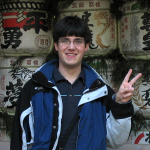
2006.01.15: Life in Okazaki (Also I am a dork in that picture)
I'm now starting my second week in Japan. I know my way around Okazaki pretty well now, as I've been riding my bike every day, sometimes for hours at a time. I've already found some great used book and game stores -- two Book-Offs and even a Hard-Off (not to be confused with Razor Lemon Hard Gay [probably not safe for work]) Yeah, television here is generally terrible.
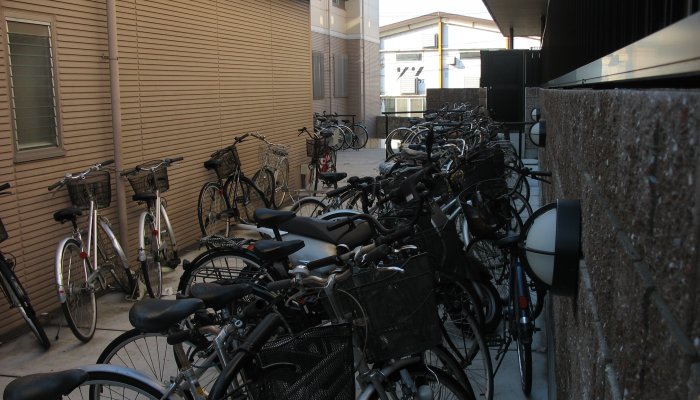
Student Housing Bike Area
As you can probably tell from this picture, a bike is pretty necessary around here. You can get by without a bicycle, but it wouldn't be easy. School is about 12-15 minutes away by foot, and the nearest Wal-Mart -- I mean "Seiyu" -- is probably about 20 minutes away.
v.jpg)
Let's Recycling!
These demented recycling bins are located right outside the Seiyu. Despite their cheerful demeanor, recycling is Serious Business over here. All garbage must be sorted into six different categories: Plastic Containers, Paper Containers, Plastic Bottles, Aluminum Cans, Flammable Trash, and Nonflammable Trash. It's incredibly tedious, and is easily the worst part of living over here. (I suppose that gives a good indicator on how good of a time I'm having overall!) Luckily, most objects come with a label that clearly says what type of trash it is.
Example: After drinking a tiny 100 yen bottle of juice, you're not supposed to just throw it away. The plastic bag from the supermarket is a plastic container, the outside label on the bottle is a paper container, the metal cap goes in with the aluminum cans, and finally the bottle itself is a plastic bottle. Now imagine doing that with everything! It reminds me of the Penn and Teller Bullshit episdode where they convinced a family to sort their garbage into a dozen different trash cans in the name of recycling.
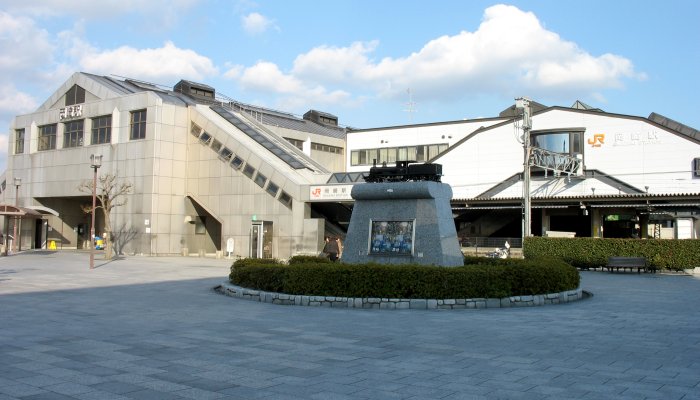
JR Okazaki
Public transportation, however, is very convenient. The JR line is about 10 minutes away by bike, and the Meitetsu line is a little farther at about 20-25 minutes away. The trains are reasonably priced and they even have heat vents under the seats. The picture above is the JR line's Okazaki station. Hopefully I'll be seeing a lot of it over the next several months.
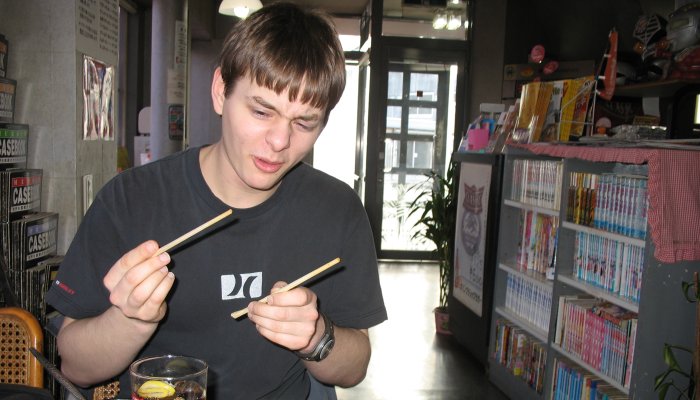
Viking
Last week, after Travis and I got our bikes, we looked around the other side of the train tracks and found a cheap "Viking" (buffet) restaurant called "Ninjin," or "Carrot." There are a lot of buffet restaurants over here, and they would be very familiar to anyone from the states, except for a slight difference -- here, they are time based. This one was around $6.50 for an hour at the buffet (drink included), which is not bad. For comparison, my most expensive meal was over $20, and my lunches usually cost around $3.50.
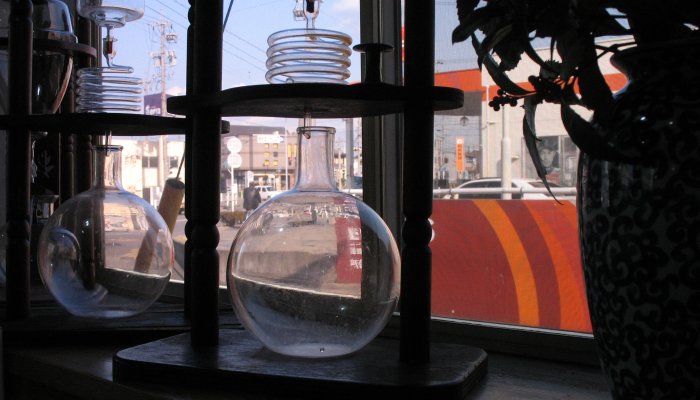
Restaurant "Carrot"
The viking restaurant had some interesting decorations, including these glass objects, which I'm guessing have something to do with chemistry. There was also a shelf of manga, some movie posters, a lot of plants, and a rack of magazines called "MURDER CASEBOOK" which featured research on famous murders and assassinations.
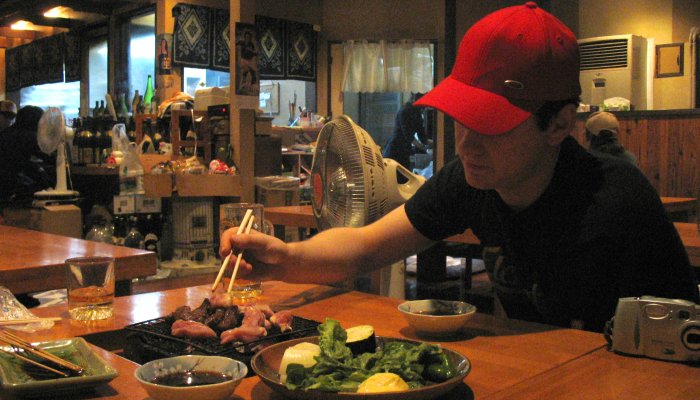
Sen-Sen Yakitori
One of the more expensive meals was at a Yakitori place about two minutes from my apartment. Yakitori is usually cooked at your own table with a conveniently located fire pit. I also ordered some sake, which was pretty good but resulted in some very poorly cooked food.
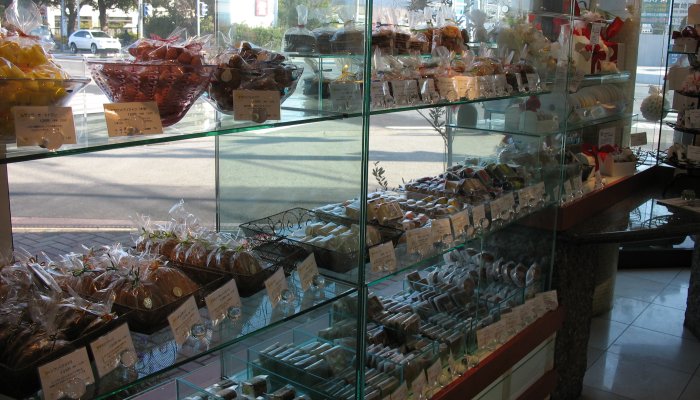
Tatsumiya French Pastry Shop
Last Sunday, I went on a field trip to a famous Shinto Shrine in Nagoya. We were to leave on the Kintetsu line, so I got up early on Sunday so I could look around that part of town a bit better. I found not only some of those great used stores I mentioned above, but also a great French Pastry shop. I got something that sounded like "shoe cream" but actually meant "Chou a la creme" -- a cream puff. It was delicious, and fairly cheap too.
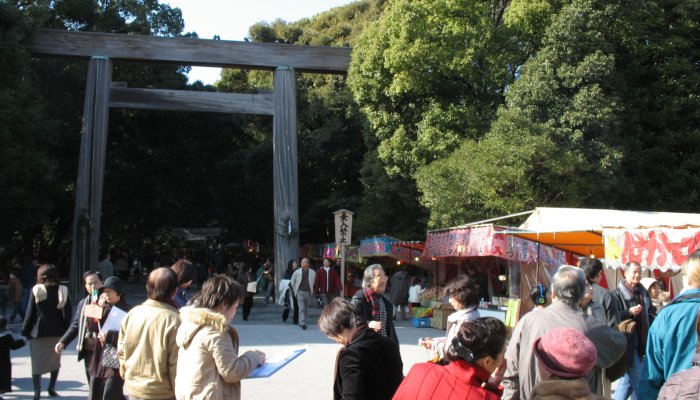
East Gate at the Atsuta Shrine
This gate, outside Nagoya's Atsuta Shrine, marks the eastern boundary of the temple grounds. After my visit to Kyoto last week, the shrine had a lot of familiar sights. Unlike the temples in Kyoto, however, Atsuta has a rather large temple ground which gave an impression of being far away from any major city. Japanese religious events seem to be a largely commercial affair, with temporary stands erected to sell various trinkets and food largely reminiscent of vendors at American carnivals. (I don't mean to put down Shintoism or anything, I actually like it!) Inside the temples, you can buy good luck charms and fortunes, and before praying to God, you are supposed to throw a money donation into the temple. At one shrine in Kyoto, a Japanese brewery even paid for a temporary shrine to house a Beer God, but since this is all taking place in such a pure and ancient atmosphere it still manages to feel spiritual.
. . . Well, maybe not at the Beer Shrine.
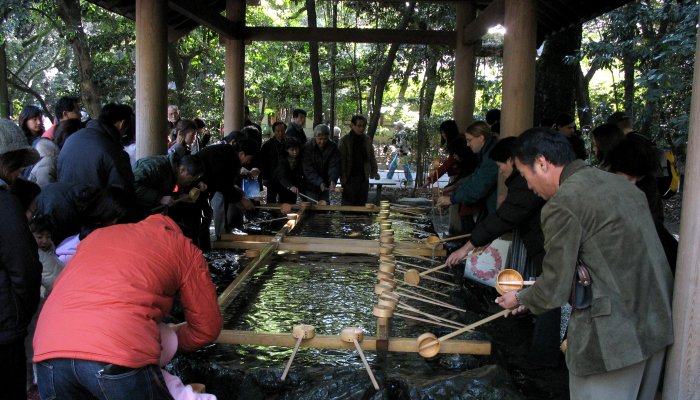
Chouzuya
Japanese shrines usually have a building near the entrance where visitors can wash their hands in the purified temple water. There is a special ritual to be obeyed, however, so if you ever visit a Shinto temple take care! Hopefully I got it right. First, you pick up the cup with your right hand, fill it water, and pour some of the water over your left hand. Next, take the cup with your left hand and wash your right hand. After this there should be a little bit of water left in the cup. Drink it. You can drink from the cup or pour it back into your hand and drink from your hand, and you can actually drink the water or spit it out into a special gutter placed in front of the pool.
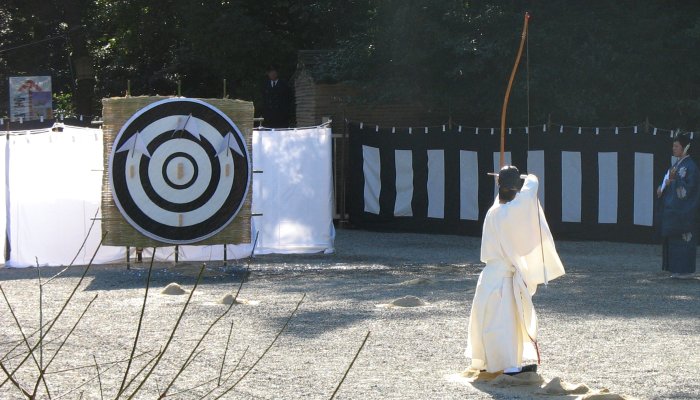
Hosha Shinji
Each year on January 15th, Shinto priests shoot 36 arrows at five wooden blocks on this target. The blocks represent evil spirits, and how well the archers perform is a sign of the year to come. If they perform well, it means a year full of good harvest and no natural disasters. We didn't stick around long enough to see how they did.
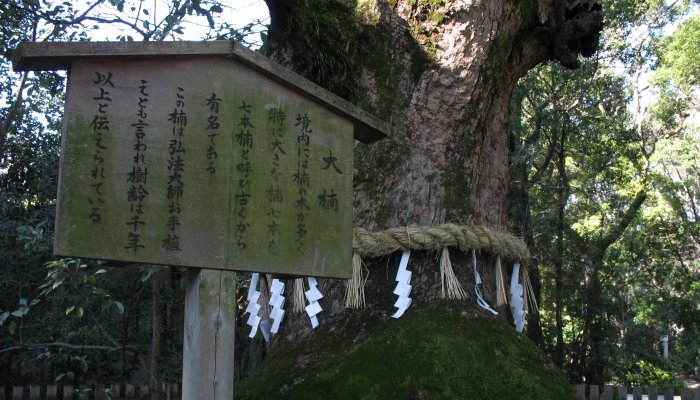
Old Tree
According to the sign, this tree was planted by Buddhist priests over 1000 years ago. I find it interesting that a tree planted by Buddhist missionaries is embraced as a major location in this Shinto shrine, but no matter who planted it, it has become a part of nature and a part of the shrine.
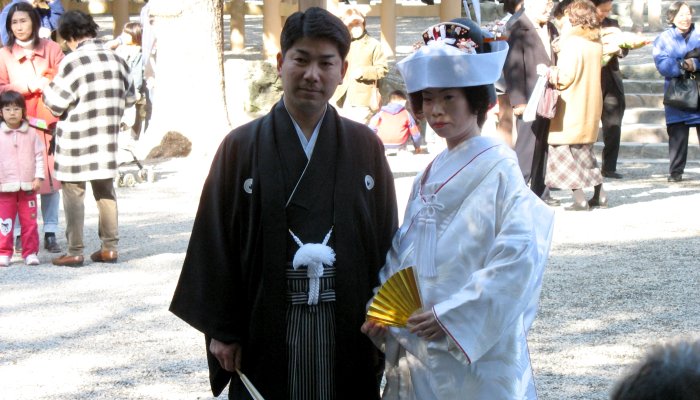
Wedding
A Japanese couple had their wedding at the shrine that day. We missed all of the ceremonies, but the newlyweds were posing for their picture when we showed up. I hope they didn't mind the crowd of foreigners also getting a picture or two in.
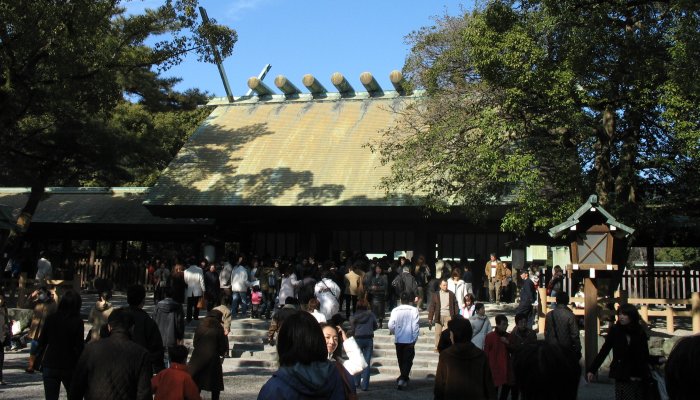
Main Shrine
This is the main shrine at Atsuta, and as such it's the primary destination for everyone on making their annual visit to a shrine at the beginning of the year. The tall roof and its decorative beams are famous as an icon of the shrine.
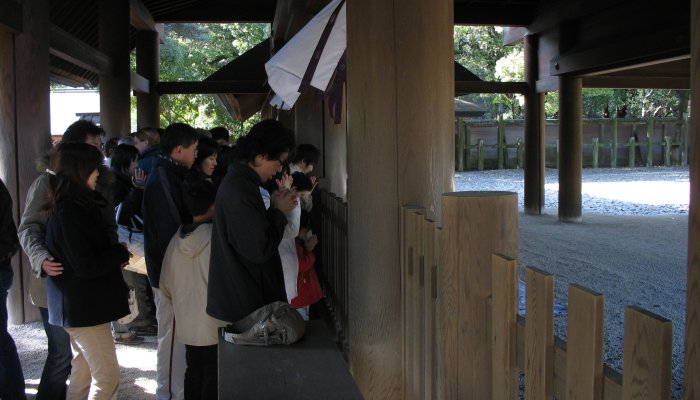
Praying
People line up the steps of the main shrine to toss money across the barrier into the temple so their request will be heard. This also has a ritual involving bows and a specific number of hand claps, but the amount of money given doesn't really matter. It's mostly about showing respect.
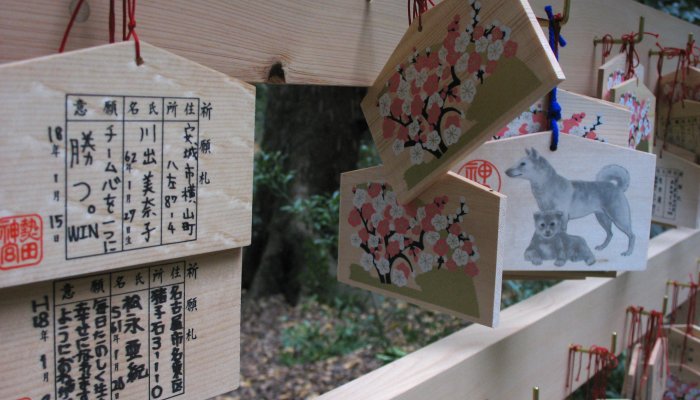
Ema
Ema provide a great example of how Shinto has evolved over the years. Long ago, wealthy people would give horses to shrines in order to gain favor with the shrine's god. Eventually, it became custom to give a picture of a horse to a shrine if the favor was small or the person was less wealthy. Now, the picture doesn't even have to be of a horse! Flowers seem to be very popular, and since 2006 is the year of the dog, there are a lot of Ema with pictures of dogs this year. This evolution seems to be due to Shinto being, at its heart, a folk religion, and I think it's better for it.
This brings me to the end of the trip and also to the end of my camera's memory card. Check back next week to see the exciting places I'll go. (And if I don't go anywhere, then I'll at least post some pictures of my room or something like that.) I hope this wasn't too boring; I know I rambled on a bit at places!