Twelve Days of Christmas Movies

December 9th, 2025 by Max Allan Collins

FOR EASTERN IOWA FANS:
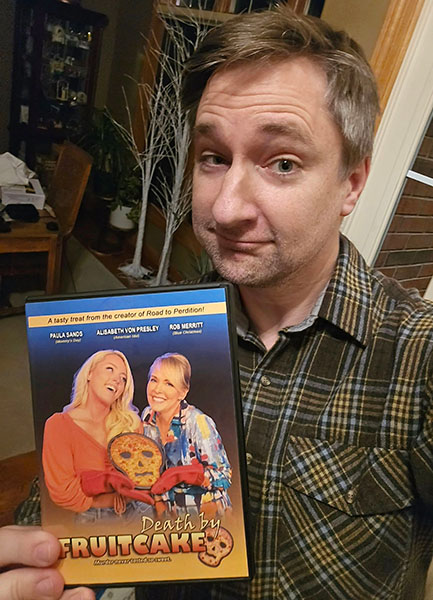
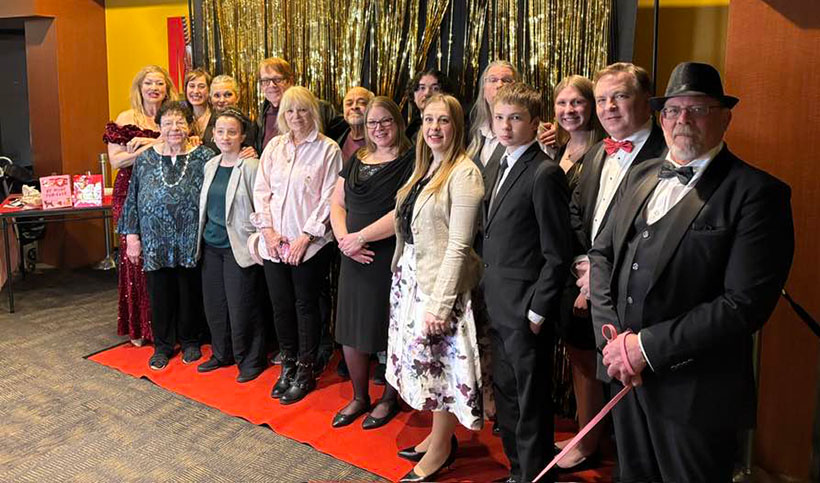
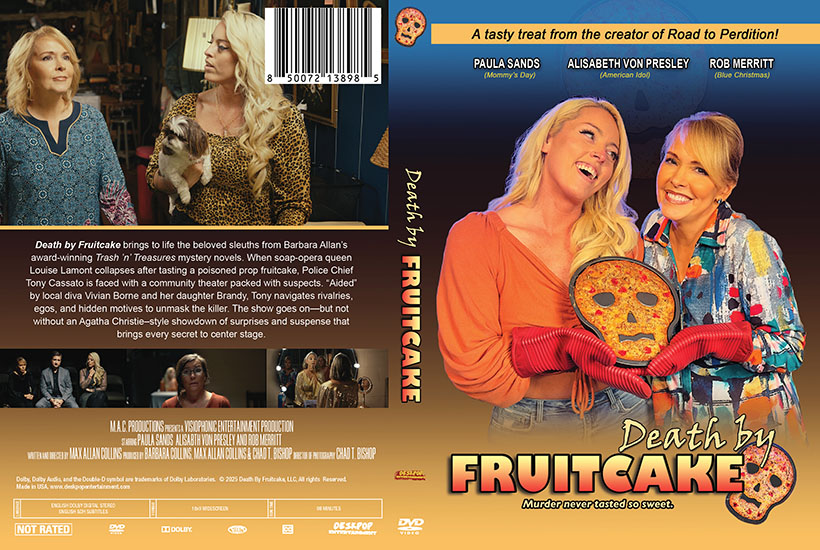
Our new movie Death by Fruitcake is screening at The Capitol Theater in Burlington, Wednesday December 10th at 7pm.

211 N 3rd St, Burlington, IA 52601

https://burlingtoncapitoltheater.com/events.html

* * *

Barb trims our Christmas tree beautifully, with an almost entirely pop culture flare. Here’s a shot of the STAR TREK section, especially for my buddy Rob Burnett.

* * *

It’s that time of year when I retread (with some new material as well) my opinions about Christmas movies. We’ll skip my five favorites (Scrooge, It’s a Wonderful Life, Christmas Vacation, Miracle on 34th Street and A Christmas Story) and move on to the 12 Days of Christmas Movies that aren’t on the Top 5 list.

1. Bad Santa (2003). This dark comedy has a warm heart, but you have to wade through a whole lot of black humor to get there. Billy Bob Thornton is wonderful, but here’s a special salute to the late John Ritter (who apparently died during the production) for the funniest moments in a side-splitting film. It’s become a Christmas classic at our house, and the very underrated sequel, Bad Santa 2 (2016), is perhaps even funnier with Kathy Bates almost stealing the picture playing Billy Bob Thorton’s mother, who deserves more coal than anybody in either picture.

2. Holiday Inn (1942) is easily better than White Christmas, although the latter has its charms – it’s helped keep Danny Kaye from being forgotten, for one, and my pal Miguel Ferrer’s mom is in it. The original has better songs and is funnier and ultimately more heart-warming. Fast-forward through the “Abraham” number with its cringeworthy Black stereotypes, less because I’m offended and more because it’s a truly terrible Irving Berlin song.

3. Bell, Book and Candle (1958) is the the movie Kim Novak and James Stewart made together right after Vertigo. With Jack Lemmon and Ernie Kovacs stealing scenes left and right, it’s a precursor to Bewitched and might seem a better choice for Halloween, only it’s set at Christmas. I love the George Dunning score (he did some of the best scores for the original Star Trek TV series).

4. The Family Man (2000) with Nic Cage, a modern reworking of It’s a Wonderful Life, heartwarming and funny. Cage may be an over-the-top actor, but the man commits – he gives one thousand percent to every performance, and this time he has a wonderful movie to do it in.

5. The Twelve Days of Christmas (2004). Okay, so it’s a shameless reworking of Groundhog’s Day as a Christmas movie, but this TV flick is funny and rewarding – good-hearted but with a darkly comic sensibility. Steven Weber is excellent as the successful slick businessman who has twelve tries to get Christmas Eve right. Molly Shannon gets her best post-SNL role.

6. Remember the Night (1940) is probably second best (after Double Indemnity) of the films Barbara Stanwyck and Fred McMurray made together. It’s written by Preston Sturges – should I really have to say anything more? – and makes its humanistic points with sentiment, not sentimentality. It’s really a gem worth looking for.

7. I, the Jury (1953). This much underrated first Mike Hammer movie is set at Christmas and plays off of that fact throughout, with Christmas cards and carols the connective tissue between scenes. I continue to feel Biff Elliott was much underrated, and the cast is filled with wonderful character actors. The great John Alton shot it. And it’s available on physical media from Classic Flix in an amazing set of Blu-ray, 4K and 3D discs (with contributions by me).

8. A Christmas Horror Story (2015) features William Shatner, excellent as the comic glue (a disc jockey) holding together inter-related stories about Krampus and Christmas. There are almost as many horror movies about Christmas as there are Christmas movies, but this is one of the best. It was put together by many of the Orphan Black people.

9. Office Christmas Party (2016) is a raunchy comedy whose preview in the theater (remember those?) turned me off. Somehow I wound up seeing it on Blu-ray and it’s very funny and eventually betrays a good heart. The great cast includes Jason Bateman and Kate McKinnon.

10. Scrooge (1970) is the second-best Christmas Carol movie. Albert Finney is wonderful as Ebenezer in this musical version, with the Leslie Briccuse score perhaps the one most like his work with Anthony Newley, who did not contribute to this score but who played in the much-seen British stage version (which came after the film).

11. Planes, Trains, and Automobiles (1987). This is perhaps the best representation of the comic talents of the late, very great John Candy and also co-star Steve Martin, game in an unflattering role.

12. Blue Christmas (2024). My micro-budget take on what has been described as The Maltese Falcon Meets A Christmas Carol. Some can’t get past the limitations of a micro-budget and frankly regional production. But I am proud of what we pulled off on an a mind-boggling $10,000…and grateful to those of you who have embraced it.

* * *

Here’s a review of French Film Noir Collection Vol. 2 (Kino Lorber), which touches upon my commentary (with the great Heath Holland) on two of the films.

Pearl Harbor day was yesterday as I write this. Here’s something that appeared a while back at ERB zine about my novel, The Pearl Harbor Murders.

Here’s where you can get Blue Christmas on physical media at a reasonable price.

Here’s how to watch it on TUBI.

M.A.C.

My Novelization Days & The Birth of IAMTW

December 2nd, 2025 by Max Allan Collins

How I spent Thanksgiving.

You only get a picture of me chowing down because Barb would not approve the one I took of her, despite her looking incredibly lovely.

We had a wonderful day, though Nate and family were off with the in-laws in Texas, making for a rough ride home, long and snow-threatened. They’re home safe, though…and we’re really thankful for that.

Thanksgiving afternoon we took in Wake Up, Dead Man, the third Knives Out movie, which is headed very soon to Netflix. Kind of a shame, because it looked great on, and benefitted from, a big screen and great sound. Good movie, maybe the best of the three. I had it half-figured out, thanks to a literal Agatha Christie clue.

This week I share with you the interview by David Spencer with me for his forthcoming The Novelizers, 2nd Edition, very much expanded. The interview covers my movie and tie-in writing and how Lee Goldberg and I formed the International Association of Movie and Tie-in Writers.

What prompted you to co-found IAMTW and, if applicable, what triggered you to take action?

MAX: As the various organizations in the various genres were ignoring media tie-ins, it seemed to me there should be a place where writers of novelizations and TV tie-ins could be honored for their best work. An award was the obvious central issue, but also connecting the writers in this difficult and unfairly ignored (and even maligned)
field.

What brought you and Lee Goldberg together in this endeavor?

MAX: I’m fuzzy on this, but I think Lee approached me, saying he and I were having the same idea simultaneously, and we’d be stronger going forward together. I agreed, and we did.

What was involved in getting the word out to other tie-in writers?

MAX: Lee and I reached out individually to writers we knew who worked in the field. A good number, like the late Peter David, were comic-book writers and I knew them personally from San Diego and other cons. Also, that con (and others) would have panels of writers who did tie-ins, and we’d hook up that way. Word spread quickly.

How did the architecture/organization of the association’s moving parts develop?

MAX: Fairly naturally. I’d been involved with the Private Eye Writers of America and we used that, at least initially, as a starting point. Also, both Lee and I were familiar with the Mystery Writers of America. We kind of combined ideas from both the PWA and the MWA.

What draws you to tie-in writing, still? It’s no longer as rare for a high-profile, mainstream writer (especially out of the science fiction category) to be regularly associated with tie-in writing as it once was, but I think you may nonetheless be among very few who walk along both roads with equal industry profile and professional enthusiasm (I think of you in the tradition of Robert W. Krepps and Al Hine). Why does your enthusiasm remain so robust? Obviously at your level it pays well, and potentially brings new readers to your original work…but as an artist, what does it fulfill in you? What do you think it contributes?

MAX: I have never considered tie-in writing a lesser endeavor in the storytelling realm. In fact, it requires a skill set other writers either lack or haven’t mastered. I started with the Disney Dick Tracy, which I lobbied for as the writer of the strip at the time. The book sold well, around a million copies; so later — after my run on the Tracy strip ended –- I sent my agent out to offer me around as a tie-in writer. I’ve always loved movies and TV, and relished the thought of being able to work outside the mystery area. I have not written much in the tie-in world lately, since the science fiction material dominates, and there are plenty of really good SFs writers out there to do novelization and tie-ins. I once almost got a Star Trek contract, but every story I pitched had already been done on one of the many ST shows. My tie-in writing for a decade and a half has been continuing the Mike Hammer series, which I did after Mickey [Spillane] himself, briefly before he died, asked me to. What makes tie-ins special are two basic things. For movie novelizations, it’s a chance for a reader (and a writer) to explore the interior of a story, movies being an exterior storytelling form. For TV, it’s an opportunity to present fans/readers with new episodes of their favorite shows, sometimes ones that have ended. An interesting case in my tie-in-career was Dark Angel, where I essentially wrote the episode before the first one (I did the origin, essentially), and another two wrapping up the series, giving it finality, when Dark Angel was unexpectedly canceled. I still get fan mail on those. My co-author there was Matthew Clemens, who worked with me on the many CSI novels, comics, video games. So I wrote the first and last episodes of the TV series.

Who were your tie-in heroes and inspirations?

MAX: The novel that got me thinking, way back in high school, was Ocean’s Eleven by George Clayton Johnson and Jack Golden Russell. This was the original 1960 movie, and the novel was very different and tougher, much more serious—the first book I ever saw the “f” word in! Johnson was a top-flight TV writer and the author of Logan’s Run. A lot of mystery/crime stuff in the late ’50s and early ’60s was tie-ins—by authors I was familiar with, like Jim Thompson, Frank Kane, Henry Kane, Roy Huggins. I discovered Star Trek mostly from the James Blish books.

What were the challenges of maintaining IAMTW?

MAX: It was not terribly challenging. Mostly it was making sure we had a convention panel to do the awards where we had presentations, and getting the nominations gathered. My wife Barb and I, for many years, got the physical awards made at a bowling alley shop here in Iowa. We’d schlep them to San Diego Comic-Con and then, back home, mailed them out ourselves to any winners who weren’t in attendance.

What were the satisfactions of IAMTW? Do you feel you accomplished your goal? What seems yet to be achieved?

MAX: I think we accomplished raising the reputation of the genre; and the awards were helpful to make sure writers felt good about who they were and what they were doing. Understand, when my agent started getting offers for me to do movie tie-ins, he was adamant that I use a pseudonym. I refused. Putting my name on them kept me honest, and tied me to some very famous properties. Saving Private Ryan was a huge bestseller for me, and tied me to a respected, celebrated property. Why wouldn’t I want my name on it? Another thing at least when I was writing them, novelizations and TV tie-ins attracted a lot of younger readers, junior high age, for example. These readers have stayed with me. Also, all these years later, I would to say my three Mummy novels got me the most fan mail. As for satisfaction, in my own career I learned a lot writing movie novels – I was, and am, typed as a mystery writer; in tie-in work, I got to stretch on everything from war novels to sword and sorcery to science fiction to westerns. It made me a better writer.

Why did you decide to move on?

MAX: As far as the field goes, I didn’t. I haven’t had an offer since G.I. Joe, which the buyer was ecstatic about. Of course, I did Road To Perdition, a movie based on my graphic novel. I think my editors moved to other houses or retired. And I haven’t solicited any work in that area for some time, busy with my own stuff and my yearly Mike Hammer commitment. In terms of moving on from the IAMTW, both Lee and I had handled it for years and, both having busy careers, just felt it was time.

* * *

This is a link to the Kickstarter campaign for Thrilling Adventure Tales, which will include my short story (with Matt Clemens), “Moriarty’s Notebook,” a Sherlock Holmes yarn, and lots of other stories by top-notch writers.

Your support for this project would be much appreciated.

M.A.C.

Thank You (and Stocking Stuffers)

November 25th, 2025 by Max Allan Collins

This will be a light week, as son Nate (who runs this page) is away with the wife and kids, so I’m chiefly going to present some links to a one article and some bargains (possible stocking stuffers) from my shelf.

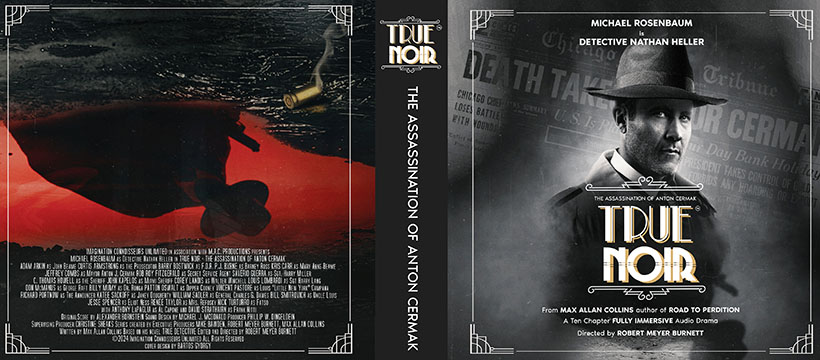
First, though, an important announcement. True Noir: The Assassination of Anton Cermak – the ten-episode, all-star almost-five-hour audio drama based on True Detective and written by me – has been picked up for distribution for Skyboat Media. Directed by Robert Meyer Burnett and starring Michael Rosenbaum as Nathan Heller, this is my favorite adaptation of my work…including the film of Road to Perdition.

Skyboat has been very supportive of my work, releasing audio books of, among others, Quarry and the Antiques series (by “Barbara Allan,” Barb and me). Here’s some of what they have available.

The great magazine True West has posted an article/interview about me from a while back, focusing on my Caleb York novels and my relationship with Mickey Spillane. I love the picture of Mickey and me (taken, I think, at San Diego Comic Con in 1994).

Now, in the stocking stuffer area…and you are free to stuff your own stocking with these as well as those of your friends and loved ones…Hamilton Books has some of my stuffable stuff, including the two most recent Heller novels (The Big Bundle and Too Many Bullets) at bargain prices.

Hamilton also has Spillane: King of Pulp Fiction, the bio by Jim Traylor and me, at a great price, also a Caleb York, and several Hammer novels. Spillane and the more recent Hammer hardcovers are not scheduled for trade paperback, so picking up a hardcover at a bargain price makes sense. Also, the trade paperback of Kiss Her Goodbye, available at Hamilton, is the uncensored version with a different ending.

Hamilton also has my micro-budget movie, Blue Christmas, on DVD and Blu-ray at the best prices I’ve seen.

Here’s where you can stream Blue Christmas.

Here are some viewer reactions to The Expert, an action movie I wrote based on the classic Brute Force. I replaced Larry Cohen (!) on the film, which is tricky to find on physical media.

You can stream The Expert here on Amazon Prime among others.

Matt Clemens and I have contributed “Moriarty’s Notebook,” a Sherlock Holmes story, to Thrilling Adventure Yarns 2026 edited by my old pal Bob Greenberger. If you dig pulpy tales, consider backing this Kickstarter campaign.

Our movie, Death by Fruitcake, will have a few theatrical screenings in December – I’ll announce dates later – but you can order the new Antiques novel right now. As I’ve said, these UK-published books can be elusive in American bookstores, so Amazon and Barnes and Noble are the best bet.

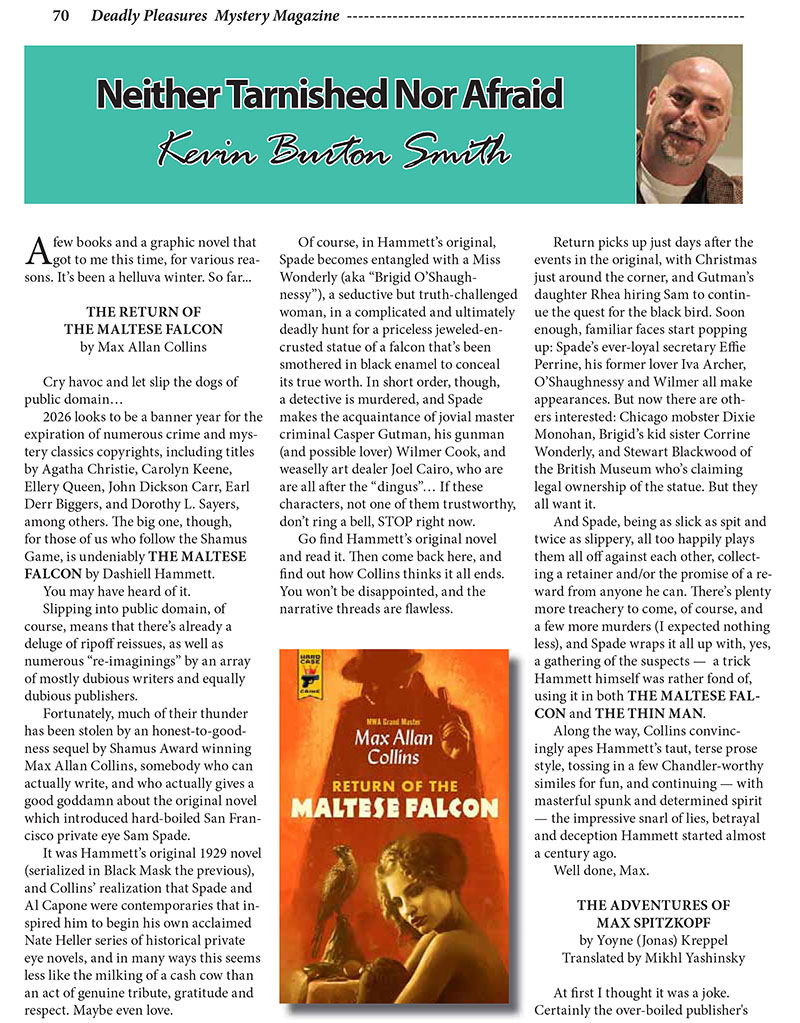
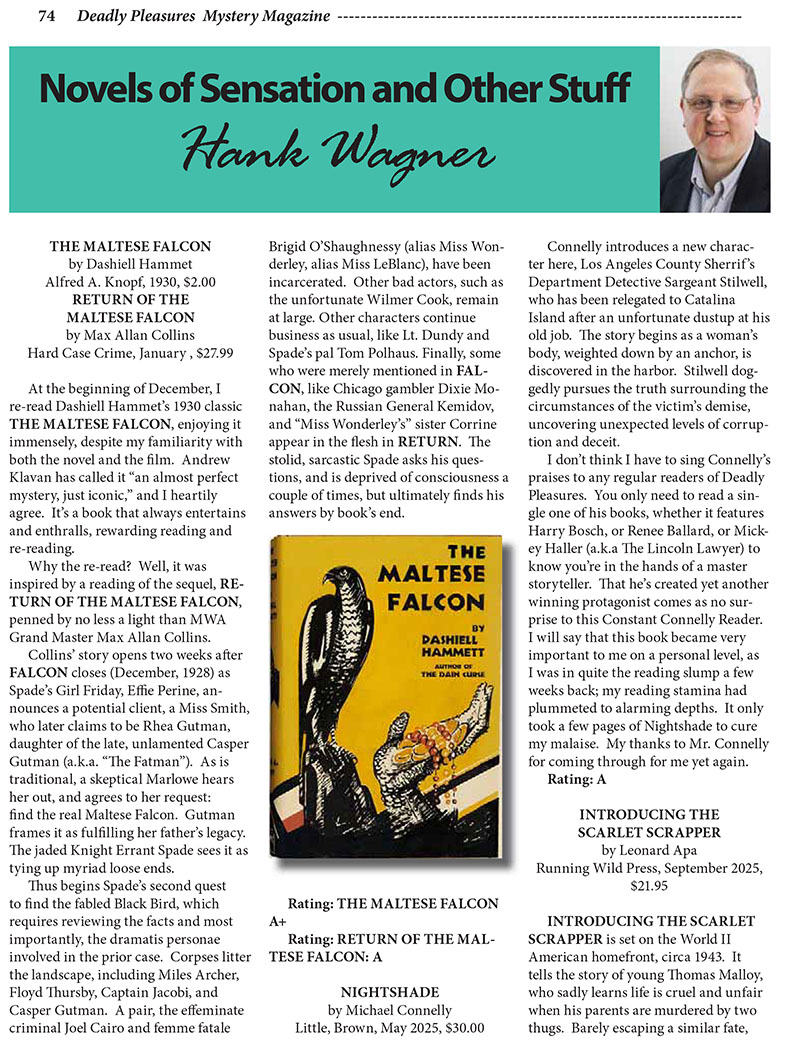
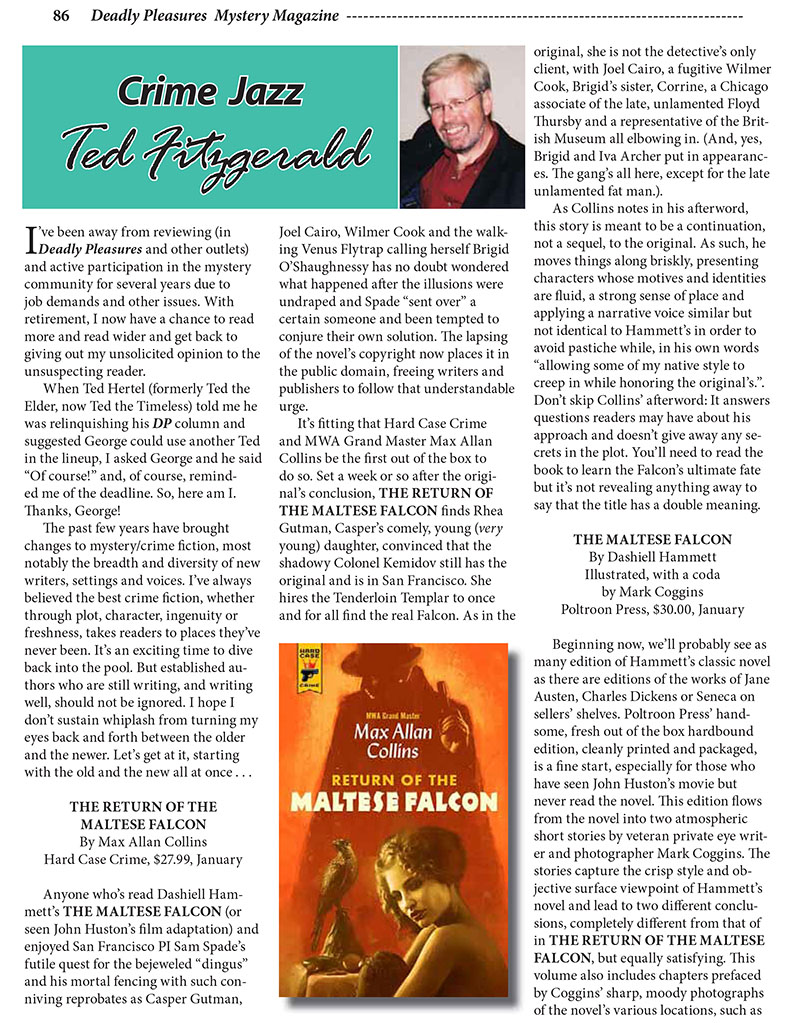
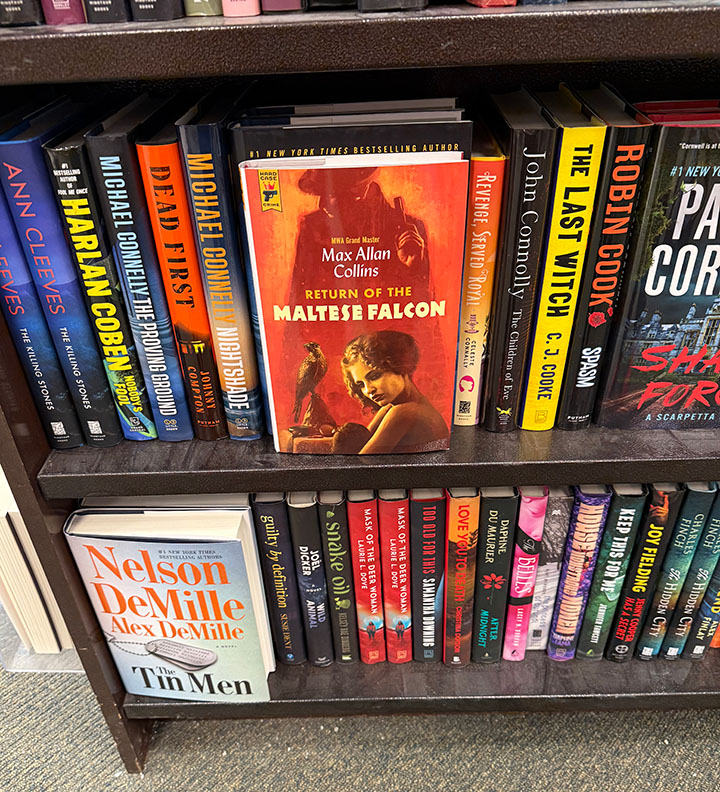
And please consider pre-ordering The Return of the Maltese Falcon.


Hardcover:
E-Book: Nook Kobo Google PLay Apple Books
* * *

I wish all of you and your families a happy Thanksgiving. I am thankful to all of you who stop by here and support my work. This time of year I think about friends and colleagues I’ve lost, grateful to have known the likes of my musician cohort Paul Thomas – with me through both the Daybreakers and Crusin’ – and actor Mike Cornelison – who was part of so many of my movie projects, notably the Mommy movies and Eliot Ness: An Untouchable Life. I’ve been blessed to know my pop culture heroes Chester Gould, Mickey Spillane and Donald E. Westlake as both mentors and friends.

And my collaborators, including (but not limited to) Matthew Clemens, Dave Thomas and Barbara Collins. They have all made me look good.

Thanks to the reviewers and bloggers who give attention to me and my work, a list I’m glad is too long to share. But I’ll single out J. Kingston Pierce at The Rap Sheet and the boys at Paperback Warrior (the graphic this week is theirs).

Finally, I’m grateful just to still be here, thanks to my family and doctors rallying to me when a routine operation had some unexpected side effects, including sending me into a hallucination right out of one of my own books.

I am not exaggerating when I say I made it back from madness thanks to my beautiful and talented wife, Barbara Collins. She is only six months younger than this ancient mariner, but she still looks like a pin-up girl.

M.A.C.

Nate Heller – History or Mystery?

November 18th, 2025 by Max Allan Collins

I occasionally get a nice e-mail from a reader who likes one thing or another of mine (or several things, which is really nice) and I do my best to answer all of these. I don’t mean to imply I’m swimming in praise, but sometimes I mean to respond and don’t get around to it. Things can get lost in the shuffle when you’re busy writing or getting a pacemaker put in.

For that reason, if you happen to be one of those who’ve written and been ignored, you weren’t really being ignored, your missive just got away from me. Please know I appreciate hearing from you. And I’m pleased to say I rarely get a negative letter from a reader.

Same goes for the comments that appear below each of these Update/blog entries. I read everything and usually respond, but not always.

Recently a reader who obviously read a lot of my stuff said the Heller novels didn’t trip his trigger like Quarry and Nolan. I get that, particularly when a reader doesn’t care for a book of the kind of length that Heller usually runs. Quarry and Nolan tend to appear in books that are quick reads – 50,000 to 60,000 or so. And Heller tends to appear in books of 80,000 words or more. True Detective was the longest first-person private eye novel ever written, until I wrote the even longer Stolen Away.

I myself find that Heller is rather daunting for me at this age. The breadth of research is staggering and the many chapters a challenge. In some ways I am a better writer now than I ever was. Mickey Spillane felt a writer should get better with age, because of being at it longer and gaining more experience in both art and life.

But in other ways I’m not the writer I was.

It isn’t just age. But the experience part Mickey mentioned applies to just being on the planet a while, and the fiction writing – like reading – depends on where you are in this string of seconds, minutes, days and years called time.

I recently re-watched The Verdict (1982) starring Paul Newman and written by David Mamet. I revisited it in part because I had been responsible in a way for the last motion picture this great film actor ever made, and had met – and been intimidated – by him. (I’ve written about that here before.)

But I am no fan of David Mamet. I find him mannered and pretty much despised his screenplay for The Untouchables. It has that great “Chicago way” speech of Sean Connery’s, but is a knuckle-headed and lazy take on Eliot Ness and Capone. I even turned down the novelization (stupidly, because it would have boosted sales of my Eliot Ness novels).

I had seen The Verdict when it came out and thought it good but overrated. Barb and I, pre-Covid lockdown, would go to at least one movie a week; and I sometimes went alone, too. So I find now, in my dotage, that I often remember nothing about a movie I saw twenty or thirty or more years ago except (a) that I saw it, and (b) remember my opinion of it.

The Verdict this time around seemed a near classic, a terrific courtroom drama and a fantastic character study from Paul Newman, who had a drinking problem in life that he explored in this particular performance. Fucking brilliant. And Mamet’s script didn’t strike me as mannered at all, and extremely well-constructed.

I am a different person going to the movies than I was years ago.

Right now I’m not going to theaters much at all, and doing considerable watching at home. You probably are the same. I’ve seen some stellar flicks in 2025 – Sinners, Weapons, One Battle After Another – and encountered some of the best TV ever, notably Slow Horses and the under-seen Chantal.

But I am also at odds with some things that a lot of people, smart people, really like – we walked out of the new Predator movie, and would have walked out on Guillermo del Toro’s Frankenstein if we weren’t home streaming it. In any case, we didn’t make it past an hour. We found it a precious thing, the kind of movie where you walk out humming the costumes.

Your mileage may vary, of course, but my point is that we see things at a specific point in time and who we are at that time – this obviously goes for books, too – impacts how we take things in. Barb and I – both of us big Breaking Bad and Better Call Saul fans – hated creator Vince Gilligan’s Pluribus. Son Nate liked it.

Nobody’s right, nobody’s wrong. Well, sometimes things are just plain bad, but you catch my drift. A novel or a film is the artist plus the someone taking in that novel or film. The reader’s mind, the viewer’s mind, is where the novel or film plays out. I often have said that sometimes my stuff plays on Broadway and sometimes at the Podunk Community Playhouse.

Of course some reviewers have considered my micro-budget Christmas movie Blue Christmas barely worthy of a community theater. But quite a few others have praised it and were able to meet it on its own modest but sincere terms.

As for Heller not tripping a reader’s trigger where Quarry or Nolan or the Antiques mysteries do, I only hope it’s not the history aspect that puts such readers off. I admit that Heller was a way for me to combine my love of historical fiction with that of hardboiled mystery fiction. Do most of my readers even know who Samuel Shellabarger was? That his novels Captain from Castille and Prince of Foxes were my favorites at the same time I was inhaling Hammett, Chandler and Cain? Or that my favorite novels as an adolescent were The Three Musketeers and The Mark of Zorro? Or that Mickey Spillane’s faves were The Count of Monte Cristo and Prisoner of Zenda? (Shellabarger, by the way, was originally a mystery writer, under several pen names.)

But to readers who duck Heller because of the historical aspect, know this: the first intension is to write a classic private eye novel in the Hammett/Chandler/Spillane (Father, Son and Holy Ghost) vein. That is the goal and I think I’ve achieved it.

Interestingly, when I moved Heller to Hard Case Crime, editor/publisher Charles Ardai was pleased that The Big Bundle was based on a less-remembered crime than other books in the Heller series. He felt the HCC audience might be put off by the historical aspect.

What prompted this rambling missive to you, Dear Readers, is a particularly nice e-mail I received, and which I will share with you now, from Andrew Lewis – a fellow Iowan!

I hope this letter finds you well. I have been a fan of detective fiction since picking up The Hound of The Baskervilles at an elementary school book fare. Over time I’ve delved into Hammett and Chandler and even some of the better Batman comic books from the late 70s, but nothing has ever punched me in the face like the Mike Hammer novels.

What Mickey Spillane does with storytelling is, in my mind, what Lou Reed did with song lyrics, say very profound things using the most simple language you can. I’m five chapters in to Kiss Her Goodbye which is, thus far, the 3rd Hammer novel I’ve read which you’ve completed. It’s hard to tell where Mickey stops and Max starts. It’s got some Black AlIey elements the same way Lady Go Die had some Twisted Thing elements, ideas set aside, forgotten, and reused. I’m all in.

I am confused about the timeline. Hammer indicates in the novel that he made it halfway through 12th grade before lying about his age to enlist in WWII. That would make him maybe 72 in 1996 when Black Alley is set. I understand that King of The Weeds is a sequel to that novel. Is there a set chronology or is it a suspension of disbelief where Hammer is always just as old as he needs to be for the story being told? My mind needs order, “foolish consistency” and all that.

I’ve recently picked up The Wrong Quarry and will be reading it after Kiss Her Goodbye. It’s my first journey into Quarry’s world, is it a good place to start? Thanks for taking the time to read this overly long note and for continuing the Spillane legacy.
Warmest regards,
Andrew Lewis
Council Bluffs, Ia

Here is the reply I sent to Andrew:

Thanks for your great e-mail.

With your permission I’d like to use it in this week’s Update/blog of mine, because you raise interesting questions that would be well answered in public.

Briefly, though, Mickey was very loose about continuity. Not as loose as, say, Rex Stout, who kept Archie Goodwin and Nero Wolfe frozen at the age at which we met them (their ages, not ours!). I have attempted to put together a continuity that doesn’t contradict Mickey, but that can only go so far. Do keep in mind Black Alley (my least favorite of Mickey’s Hammer novels) is his final Hammer novel, and King of the Weeds was a direct sequel he began as was Kiss Her Goodbye — he set aside King of the Weeds, intended to be the final Hammer, to write a 9/11 novel, The Goliath Bone. I finished both King and Bone and kept them in relative continuity not only with Black Alley but with the entire series. King of the Weeds, by the way, is in part meant to answers questions and fix inconsistencies in Black Alley. I liked to think (and this is outrageous I know) that I “fixed” Black Alley — that reading Alley and King back to back is an improved experience…the “part two” that Mickey began writing.

I always tried to set each story that I completed in time — specifically, when Mickey started (and set aside) those unfinished novels. I try to think about where Mickey was in his life, and get into his head space at that point. This means Lady Go Die is like an early Hammer, and King and Bone like later Hammers in tone and technique. Kiss Me Darling is another one that has that early feel. Kiss Her Goodbye is more mid-stream Mickey — he designed it to be Hammer’s return to the book market after a long quiet spell…but during that quiet spell, he kept starting (and stopping) various Hammer manuscripts.

I would recommend you read my biography of Mickey, co-written by James Traylor — Spillane — King Of Pulp Fiction. I include as part of a back-of-the-book bonus content a lengthy article about how I came to write the books and how I approached each of them.

Thanks again, Andrew! Let me add to that one thing: I am very fond of Black Alley (and not just because it’s dedicated to me). I grew to respect it more working with it in depth writing its sequel from Mick’s existing chapters. My disappointment with the book was the way he softened a banger ending that he shared with me in conversation, which I wound up using in slightly different form in another Hammer.

M.A.C.