Posts Tagged ‘Quarry TV’

Quarry’s Web

Tuesday, September 29th, 2026

The new Antiques novel by Barbara Allan (Barb and me) is out now! Brick-and-mortar stores may not have it (our publisher, Severn House, now affiliated with Joffe Books, is British) but Amazon does, in both hardcover and on Kindle.


Hardcover:
E-Book:

Here’s what reader Mary S. thinks about the new Trash ‘n’ Treasures mystery:

“Antiques Web is the latest in the Trash’n’treasures mystery series featuring mother daughter duo Vivian and Brandy Bourne and adorable shih tzu, Sushi. This series has been running for a long time and possibly could feel a little formulaic, but it really doesn’t because it’s so darned funny! I love the mother daughter duo and their sweet family that now includes Brandy’s son Jake and her police chief husband Tony. The setting in small town Iowa is great and the hijinks drama queen Vivian gets into are hilarious. This mystery involved murder, a UFO house, and the mob. What more could we really ask for! If you are looking for a cozy mystery with lots of humor that is a great escape from real life then this is the book for you! I loved the ending and I’m already looking forward to the next book.”

And Navy Mom says:

“This book is a positive mood lifter. I have never laughed so much while reading a murder mystery. The main characters are family and friends who run a Antiques shop called “Trash “n” Treasures.” Thus fabolous sweet read has embezzlement, a Mafia connection, a Sheriff who is beside himself as his wife & her Mother get involved in solving crimes. I totally loved this series, and I think I’m going to have to but Book 1 and complete them all.”

And our little micro-budget movie, Death by Fruitcake, is available at Amazon right now, regularly $22.29, but it’s been on sale a couple of times lately, so keep an eye out.

It’s free with commercials on Tubi, The Roku Channel, Fawesome and Xumo Play. Check here for more options: https://www.justwatch.com/us/movie/death-by-fruitcake.

If you hit one of the sale prices (it’s been as low as $6.66!), snag some for friends, relatives and to use for stocking stuffers.

Here’s a review that may convince you:


Five stars from reviewer zagain
.
Solid Independent Film
Reviewed in the United States on February 24, 2026

“Death By Fruitcake is an adaptation of a novella by Barbara Allen from the Trash ‘n’ Treasures cozy mystery series. Allen is the pen name used by noted crime and mystery writer Max Allan Collins and his wife Barbara who co-write these adventures of antiques store owner Vivian Borne and her daughter Brandy. The film is set in small-town Serenity, Iowa and focuses on a community theater production of a Christmas play centered around local fruitcake production during the FDR administration. Vivian is directing the production and it stars local star Louise Lamont, who has recently returned to her hometown roots while on the downside of her successful career in soap operas and other stage shows. Things go awry when Lamont, a diva who has rubbed the rest of the cast and crew the wrong way, dies in the middle of a dress rehearsal. Vivian, who views herself as something of an amateur sleuth, takes it upon herself to assist local police chief Tony Cassato in solving the crime.

The film stars Paula Sands, a long-time news anchor and reporter in the Quad Cities area, as Vivian Borne and Alisabeth Von Presley, best known for her music career and as a former contestant on American Idol, as her daughter Brandy. The film also features Rene Mauck, who portrayed Velda in the filmed stage radio-style production of Mickey Spillane’s Encore for Murder, as Louise; Rob Merritt (Richard Stone in Blue Christmas) as Chief Cassato; and Chris Causey (Jake Marley in Blue Christmas) as Paul, the theater’s lighting guru. While the cast may not contain a number of household names, there are some solid performances in the film. Sands does a solid job as Vivian, although some of her delivery certainly points to her past at a news desk. Von Presley, who had a minor role in Blue Christmas, stands out with an ability to easily speak to the camera in several scenes designed to break the fourth wall. Merritt, who was strong as the lead in Blue Christmas, puts in another solid performance as does Chris Causey, who has the presence of an experienced character actor (making it somewhat surprising that he’s not had more roles according to his IMDb profile). Kimberly Kurtenbach also stands out as Clara Buffet, head of Lamont’s fan club.

The film is a low budget, independent production, but that works just fine given that this is a character-driven, quick (89 minutes) whodunit film that takes place entirely in one setting (the community theater). There are several funny spots and one-liners as well as an ending with a twist that is to be expected in these types of mystery stories. Although I’m unfamiliar with the book series this is based on, it’s safe to assume it is a fairly true adaptation given that it is written, directed and produced by Max Allan Collins and also produced by series co-writer Barbara Collins. Overall fans of the series, of cozy mysteries, or of Collins’ work in general are likely to find this film a worthy watch.

Here’s another FRUITCAKE review that just came to my attention:

Overly Honest Reviews – *** ½ stars
RAVING REVIEW: One of the best types of mysteries doesn’t pretend to be bigger than it is.
DEATH BY FRUITCAKE leans into its small-town setting, its contained stage environment, and its personality-driven storytelling without trying to inflate the stakes beyond what the story can support. That restraint ends up being one of its biggest advantages. It knows the scale it’s operating within and, instead of stretching, digs inward into character, tone, and timing.

The setup is simple in the best way. A dress rehearsal collapses into chaos when a notoriously difficult actress drops dead mid-performance, and suddenly everyone in the room becomes a suspect. That kind of confined, single-location mystery has been done countless times, but what makes this one click is the attention it pays to the personalities circling the event. This isn’t about elaborate plotting or intricate twists stacked on top of each other. It’s about letting the audience sit in a room full of people who all have a reason to hate the victim and watching the tension build from there.


Paula Sands carries much of the story as Vivian, and what stands out isn’t just her presence but the way the performance embraces a slightly heightened delivery without tipping into parody. There’s a stiffness to her line reading at times, but instead of breaking the illusion, it almost feeds into the character. Vivian feels like someone who sees herself as more composed and authoritative than she actually is, and that disconnect becomes part of the charm. It’s not polished conventionally, but it fits the world the film builds.

Alisabeth Von Presley brings a different kind of portrayal as Brandy, and the contrast between the two performances becomes one of the film’s strengths. Where Vivian leans toward control and presentation, Brandy feels more fluid, more aware of the absurdity around her. The moments where she interacts directly with the camera could have come off as distracting. They’re used sparingly enough that they add personality instead of pulling you out of the story. It gives the film an edge, a reminder that it’s in on its own tone without constantly pointing it out.

The supporting cast fills out the ensemble, keeping the suspect pool engaging. No one is pushed into satire, but everyone is just exaggerated enough to feel distinct. That balance is important in a story like this. If the characters blend into one another, the mystery loses its shape. Here, each interaction carries just enough tension or humor to keep things moving, even when the narrative slows.

The investigation expands in a way that feels intentionally relaxed, but there are stretches where it could have used a sharper sense of escalation. Conversations feel a bit repetitive at times, suspicions shift without always adding new information, and the momentum dips as a result. It never stalls completely, but there’s a version of this that trims some of that repetition and lands with a bit more impact.

There’s a lightness to the humor that doesn’t undercut the mystery, and a sense of familiarity that works in its favor rather than against it. It feels like a story that understands its audience, especially those drawn to mysteries where the intrigue matters but the experience is just as much about spending time with the characters. The jokes land more often than not, and when they don’t, they still feel in line with the world the film has created.


The single-location setting becomes a strength rather than a constraint, forcing the film to rely on blocking, performance, and dialogue rather than on visuals. There’s a stage-like quality to everything, which makes sense given the setting, and instead of fighting that, the film leans into it.

What ultimately holds everything together is the film’s understanding of what kind of mystery it wants to be. It’s not chasing complexity for its own sake, and it’s not trying to reinvent the genre. Instead, it focuses on delivering a contained, character-driven story with enough intrigue to keep you guessing and enough personality to keep you invested.

There’s also an underlying appreciation for the setting itself. The small-town dynamics, the overlapping relationships, the way grudges and histories linger just beneath the surface, all of that feeds into the mystery without needing to be spelled out. It gives the film a sense of place that adds texture without complicating the narrative.

DEATH BY FRUITCAKE doesn’t aim for perfection. Its appeal comes from how comfortably it settles into its identity. The imperfections are part of the experience, but they don’t define it. What sticks is the chemistry between its leads, the playful tone, and the steady commitment to telling a story that fits its scale. It’s the kind of film that understands exactly what it’s offering, and more importantly, what it isn’t. And in a genre that often overreaches or overcomplicates itself, that clarity goes a long way.

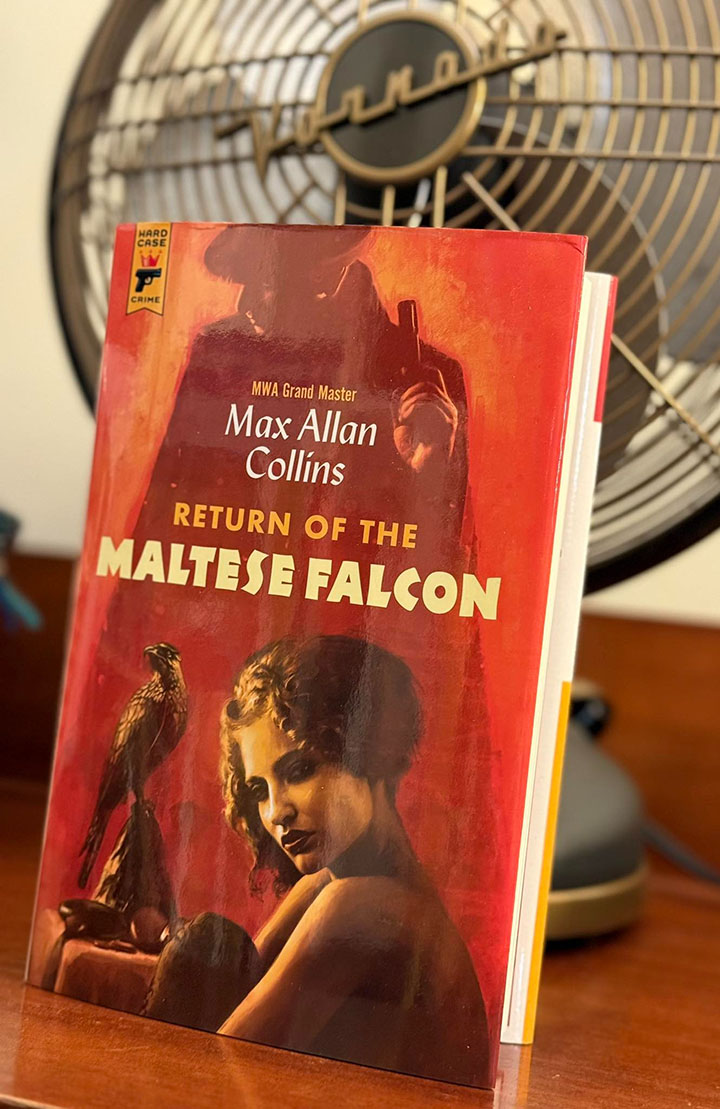
This same reviewer also likes Return of the Maltese Falcon:

from reviewer zagain:
5 out of 5 stars
Excellent Followup
Reviewed in the United States on April 4, 2026
Format: Hardcover

Dashiell Hammett’s
The Maltese Falcon from 1930 is a whirlwind of a hardboiled novel in which you are thrown right into the story. There’s no long preamble introducing characters or settings — characters quickly enter the scene and the action starts immediately. It can be almost disorienting at first with how quickly things begin happening and with characters coming into and going out of the plot. The overall story is well-known to most thanks to John Huston’s film noir classic starring Humphrey Bogart, and the ending to the tale is perfect given how frenetic the rest of the story was executed.

BUT…. it’s hard not to wonder what happens next with Sam Spade and the motley crew of would-be crooks.

And Max Allan Collins provides a solution for that nagging question with his Return of the Maltese Falcon follow-up. Much like the original, Collins wastes no time with a long setup as the story begins immediately and characters, both new and old, quickly make their way into the plot. Like the original, the Return features several twists and turns; a cast of characters who may or may not be who they claim; fisticuffs; sarcastic quips from Spade; and a bird statue that’s caught the attention of many.

Collins is no stranger to working with characters created by others and finishing tales began by other classic authors — he was handpicked by Mickey Spillane to complete all of his unfinished works; authored the Dick Tracy comic strip for a number of years; wrote the Batman comic; and even provided novels for the popular CSI television series. And not surprisingly, he does a fantastic job with Hammett’s classic PI Sam Spade in this follow-up.

Overall this is an excellent read that holds up to the quality of the original.

This may have appeared here before, but if you haven’t read it – particularly if you haven’t read my Return of the Maltese Falcon – this might encourage you to do so.

Return of the Maltese Falcon (2026) by Max Allan Collins

The Maltese Falcon is both a seminal novel (1929) in the private eye genre and one of the most classic movies ever made. The 1941 film, which were are all intimately familiar with (or should be), starred Humphrey Bogart in an immortal role as well as Mary Astor, Gladys George, Peter Lorre, and Sydney Greenstreet. It is amazing that Sam Spade (the private eye character) only appeared in one Hammett novel (The Maltese Falcon) and a handful of short stories. The character, perhaps propelled by the silver screen success of John Huston’s version, has assumed proportions which are larger than life. Spade is perhaps more well known as a private eye than almost any other literary figure other than Sherlock Holmes, who was a product of a different era.

Collins’ Return of the Maltese Falcon is a pastiche, that is, according to the American Heritage Dictionary, “[a] dramatic, literary, or musical piece openly imitating the previous works of other artists, often with satirical intent.” Collins tells us readers in an afterward that he based his novel solely on the original 1929 work and ignored the movies and other pastiches. He does admit though that he is, in doing this, like “a buzzard picking at the Falcon’s bones.”

(NOTE FROM MAC: I do not consider Return of the Maltese Falcon a pastiche because it is utterly devoid of satirical intent. My quoted “buzzard” remark, however, is.)

The novel continues less than two weeks after the first one (the one that Hammett wrote) left off. Sam Spade is now in his office, savoring the fact that he put Brigid O’Shaughnessy in jail for Archer’s murder. He is satisfied that he has avenged his one-time partner, Miles Archer, though he candidly states he had no love for Archer and had been fooling around with Archer’s wife, blonde, blue-eyed and painfully pretty Iva, which made him a suspect in Archer’s murder. The match-up between Spade and Archer had never been a good match and their three-year contract was close to running out when Archer died. His name has now been razored off the door.

Effie Perine, his secretary, plays a strong role in this novel, with semi-romantic sparring between them. The story quickly switches to the Falcon as Rhea Gutman, the daughter of Casper Gutman, the infamous seeker of all things Falcon, approaches Spade and hires him to find the Falcon, once again, but this time the real one. She explains that her only inheritance is her father’s quest for that golden bejeweled bird.

What follows is a sort of trip down memory lane with Spade visiting both Brigid and Joel Cairo, soliciting their help. Along the way, Spade is hired by more than one person in their quest for the Falcon with him quietly pocketing retainers left and right, hoping that it will all sort itself out in the end. Brigid continues her femme fatale role as a “supplely shapely female” with “nearly violet eyes, half-lidded and languid under long lovely lashes.” She is still a siren’s song even in jail.

Spade, a former Continental Operative, but not Hammet’s famous unnamed Continental Op, admits that he has not been known to play things by any one’s rules but his own, and states that the assumption that he is “outright crooked misses the point.” He says he is in the detective trade and his partner was murdered so he had to do something about it. San Francisco has no shortage of suckers, he explains, and never think that he is one of them.

Return of the Maltese Falcon is not the original The Maltese Falcon, but perhaps it is the next best thing. It offers us another chapter in that chase for the elusive treasure and the collection of odd ducks who are after it. It revisits familiar characters and breathes new life into them. And it is just plain fun to read.

The HBO/Cinemax Quarry series is on a list of underrated TV crime dramas.

* * *

On Tuesday (I am writing this on Sunday) I will be recording a Blu-ray commentary with moderator Heath Holland and Jeffrey Goodman, the director of The Last Lullaby (2008). That’s the Quarry movie starring Tom Sizemore based on my short story, “A Matter of Principal,” and my script for the film, which I turned into the novel The Last Quarry. Before filming, a second writer did a pass on the script, after my two drafts; and I did a punch-up of sorts after that.

Quarry is called “Price” in the film because I didn’t want to tie the character up for subsequent films.

Kino Lorber is bringing it out on Blu-ray, much to my delight (I like the film), in conjunction with Quarry’s 50th anniversary (the first novel appeared in 1976, The Broker now called Quarry, my preferred title). Release date of the Blu-ray TBA.

I am hopeful the short Quarry film will be included on the special features of the Blu-ray. Fingers crossed.

M.A.C.

Hey Kids! Sam Spade Book Giveaway (and More)!

Tuesday, December 30th, 2025

January 6, 2026, approaches, meaning Return of the Maltese Falcon finally goes on sale at Amazon, Barnes & Noble and the usual suspects. (Hardcover: | E-Book: Nook Kobo Google PLay Apple Books)

[All copies have been claimed. Thank you for your support! –Nate]

We are celebrating with a free book giveaway – thanks to the kind folks at Hard Case Crime (“folks” being editor/publisher Charles Ardai), I have secured 20 copies of my Sam Spade sequel for the first twenty among you who contact me (with apologies to Nero Wolfe for using contact as a verb) at macphilms@hotmail.com requesting a copy. I will sign and (if you request it) personalize these copies.

The rules: you must include in your e-mail your snail-mail address (even if you’ve won before); and you agree to write a review at Amazon and/or Barnes & Noble. Reviews on personal blogs are also encouraged. (If you dislike the book, you are encouraged not to review it!)

If you review for an on-line mystery site and want to review it, let me know and I’ll get you a copy, not from this batch of twenty.

Unfortunately, no Canadian or other foreign entries can be honored. International postage rates are higher than ever (aren’t tariffs wonderful?). I wanted to send a friend in Germany a copy and it would have cost $80.

IMPORTANT: DO NOT SUBMIT YOUR AMAZON REVIEW OF RETURN OF THE MALTESE FALCON BEFORE PUBLICATION DAY, JANUARY 6. THEY WILL NOT USE IT OTHERWISE!

Those of you who have already pre-ordered, thank you. And anyone who picks this up, thank you, paying customer!

This is an important book for me – both in the creative sense, bringing my love for private eye fiction full circle, and in trying to stay relevant in a publishing landscape where many of my readers are (choke) no longer with us, and lots of my editors have retired. Plus, publishing generally sucks.

I have been lucky so far to stay afloat thanks to the loyal readers who have stuck with me or discovered me recently and liked what they saw. Barb and I are grateful to all of you.

Speaking of Barb, she is just finishing up her draft of Antiques Web for Severn House and I will be starting my draft at the beginning of January.

Thank you all of you again, and let’s have a better 2026. Shouldn’t be hard, but it likely will be.

* * *

In the meantime, check out this great review from Kirkus, the third of the three major book review outlets to give a rave or near rave to Return of the Maltese Falcon. This is especially gratifying, since in the past Kirkus has frequently implied that my true calling was my previous job: sacking groceries.

RETURN OF THE MALTESE FALCON
Max Allan Collins

Did you ever imagine that The Maltese Falcon could spawn a sequel? Well, Collins has, and although it’s no match for Dashiell Hammett, it’s surprisingly successful on its own terms.

After all, Hammett’s novel ends a bit up in the air, with (spoiler alert) Brigid O’Shaughnessy on her way to jail for killing Sam Spade’s partner, Miles Archer, but scheming, bloated Casper Gutman’s gunsel Wilmer Cook escaping after the precious falcon behind all the novel’s intrigue is revealed to be a phony. So why shouldn’t Gutman’s daughter, Rhea, call on Spade just a week later, as Christmas 1928 approaches, to hire him to track down the bird that the untrustworthy supplier, Russian general Kemidov, replaced with a fake? Spade agrees, and soon he has a stable of four clients—Rhea, Chicago gambler Dixie Monahan, British Museum curator Steward Blackwood, and Corrine Wonderly, Brigid’s kid sister—each of whom, unknown to the others, has paid him a retainer to locate a treasure none of them intends to share with anyone else. There’ll be more fatalities, of course, including two members of the original cast, before Spade gathers his clients together for a Christmas party at which he stages exactly the sort of denouement Hammett consistently took pains to avoid in all his fiction. Collins’ dialogue sounds pleasingly like Hammett’s; his plotting is even twistier; and if his descriptions mix Hammett’s terse, affectless minimalism with Raymond Chandler’s fondness for florid similes, that’s clearly, as he notes in an engaging coda, his intention.

Fans convinced that nobody could possibly continue a tale that ends so definitely owe it to themselves to give Collins a try.

* * *

Christmas may be over, but ‘tis still the season (for a few days anyway), so if you haven’t already watched our little micro-budget movie Blue Christmas, there’s still time to view it in a Yuletide context.

We’ve recently been accepted on You Tube, after jumping through a few hoops, but it’s available a bunch of places:

Tubi, Fawesome, or rent/buy it on Amazon Prime Video, with it sometimes appearing on library services like Hoopla. Some of these involve commercials – Tubi, I believe, opens with some ads and then the movie plays without further interruption.

I found the following review most insightful. If you’re a fan of the movie or of my work in general, check this out.

* * *

The HBO/Cinemax series Quarry, based of course on my book series, is number 2 on this list of worthwhile shows you may have missed, describing it as having a “beautiful visual style, and a gripping story – Quarry is an underappreciated classic worth discovering.”

I wrote an episode of the series and received a sole screen credit, but actually it was spread across two episodes by another writer who took the other sole credit. Just a Hollywood thing.

I’m proud of the show and, if you like the book series, you will probably like it. It does lack the dry humor of the novels, and moves the action to Memphis (one of the Quarry novels does take place in Memphis, Quarry’s Climax). And the concept of Quarry tracking other hitmen for targeted clients was something set for the second season (for which I wrote an episode and was paid for doing so) that never happened.

My understanding about why that second season did not get a greenlight is that the show runner and star clashed, refusing to work together again. That’s not a fact, just what I heard from insider sources. Again – Hollywood.

The real Quarry is coming from Hard Case Crime in 2026 in Quarry’s Reunion, but that will be late in the year.

2026 is all about Return of the Maltese Falcon.

M.A.C.

R.I.Pee Wee, Mike Hammer at the Movies, E-Bay Deals

Tuesday, August 8th, 2023
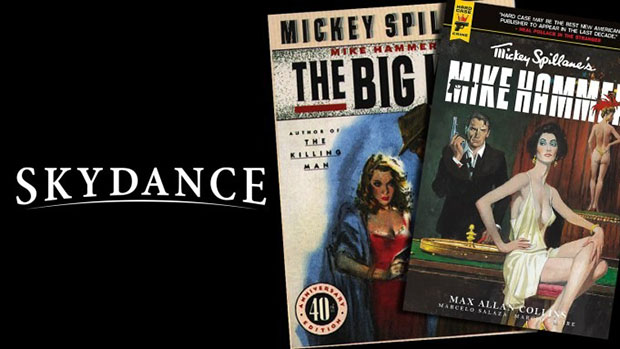
Skyline and Mike Hammer banner

The big news this week should be that the long impending Mike Hammer movie deal with Skydance has solidified, and been announced in all the trades. The upside is that Skydance has purchased the film rights for the entire franchise, which includes the books I’ve co-authored. The downside is…things like this, announced or not, often do not come to pass.

Yes, I am an executive producer. That often simply means that when you come to make your set visits, a director’s chair with your name on the back is waiting. On the Cinemax Quarry set (where I was suffering, unknowingly, congestive heart failure) they didn’t let me near the director and other mucky-mucks till they needed me for photos. And I was, again, an executive producer.

I often have mentioned that I did not tell my parents about the Road to Perdition movie sale till Barb and I were on set watching Tom Hanks and Paul Newman shooting scenes under the direction of Sam Mendes.

The news this week that impacted me more, personally, was the loss of Paul Reubens, who had been privately battling cancer for half a dozen years.

Paul Reubens dressed in black with a Pee-Wee Herman Doll in his breast pocket. Art Streiber / August @aspictures

I have frequently commented here about the annual Christmas cards that Barb and I have received from Paul Reubens over many decades. To me it has not officially been Christmas until the Pee Wee card arrives from Paul.

Here’s what I wrote in December 2013:

For me, Christmas begins when I receive my yearly Christmas card from Paul Reubens. Sometimes Paul writes a personal note. The cards are always charming and even hilarious, and we have easily two dozen of them. This year Barb made a wreath out of some our favorites.

I went crazy over Pee-Wee with his HBO Special, The Pee-Wee Herman Show in 1981. I was doing the Dick Tracy strip at the time, and I put Pee-Wee in the strip – he was on television saying, “My name’s Pee-Wee – what’s yours?” And a TV-obsessed villain of mine replied, “Splitscreen!”

Paul Reubens phoned me shortly after that, delighted by the Tracy appearance, and we chatted. Shortly after that, taking time out from a San Diego con, Terry Beatty and I visited Paul in LA – he was in a small one-story brick house filled with funky toys and oddball memorabilia. We watched a version of The Pee-Wee Herman Show that the cast had looped with blue improv material. The Pee-Wee Herman suit was on a coat tree. I asked Paul how many of those suits he had, and he said, “Just the one.” Then, noting my surprised reaction, he added, “Sometimes Pee-Wee doesn’t smell so good up close.”

Paul knew that I was a movie buff, and he was working on getting a Pee-Wee film going. Late at night, we would talk on the phone and (at his request) I would send him Betamax copies of offbeat films like Eddie Cantor’s Roman Scandals and Russ Meyer’s Faster Pussycat, Kill! Kill! He called once every month or two for a couple of years, sometimes when he was off shooting a movie. (One was a Meatballs sequel, and I asked him what it was about. He said, “A virgin sees her first dick.” I thought he was kidding till I saw the movie.) Barb and I (and sometimes Terry) would go to live shows of Paul’s, and we’d see him after – we did this in New York and Chicago.

When the Pee-Wee movies and TV show kicked in, Paul changed his phone number and I haven’t heard from him since…except at Christmas. Always a wonderful card, and sometimes a warm personal note. I still love Pee-Wee Herman, and it’s been a nice perk of my minor celebrity that I got to know Paul Reubens a little. It’s very thoughtful and generous of him to send me these fantastic cards every year.

Shortly after the above piece appeared, Paul got back in touch with me – someone had forwarded the posting about him – and we began occasionally exchanging e-mails. Knowing Paul, and having a small impact on his work (Faster Pussycat, Kill! Kill! had an obvious influence on a sequence in Pee Wee’s Big Holiday), is one of the most amazing things that has happened to me in an amazing life, despite never having moved from the small Iowa town where I was born.

This is my reflection on the passing of John Paragon, Paul’s partner in comedy – the great, much lamented Jambi.

Paul wrote me thanking me when he saw this tribute to his friend and collaborator.

I don’t know what else to say about Paul and Pee Wee. We weren’t close friends exactly, but we were real friends and the sadness I feel is hard to communicate. But he contributed a character, a concept, and point of view that I truly think will last until (as Paul Williams wrote) “the sun is just a bright spot in the nighttime.”

* * *

A flurry of M.A.C. e-books sales at Amazon have hit and I will share them with you now.

First, True Crime will be $1.99 on August 8 only, the day this update/blog appears.

From now till August 31, Girl Can’t Help It will be on sale for $2.49. If you haven’t read this one yet, please pick it up – this is one of only two titles (the other being Girl Most Likely) that have not “earned out” at Amazon and have apparently impacted their decision not to publish anything else new by me.

From now till August 31, Million Dollar Wound (Nate Heller), What Doesn’t Kill Her (Matt Clemens and me doing our American riff on Girl With the Dragon Tattoo), and Midnight Haul (my Mallory-ish eco-thriller) will all be available at $1.99 at Amazon on e-book.

Also wading in to the e-book wars is Wolfpack, who are doing e-book boxed sets that are an opportunity to pick up a lot of my backlist (some of which is out of print) at a low price.

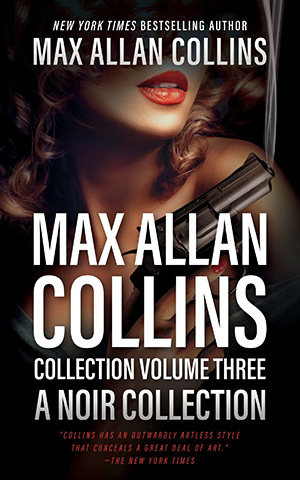
The Max Allan Collins Collection Volume Three collects all three Jack and Maggie Starr mysteries as well as the Westlake-ish Shoot the Moon for under four bucks (okay, a penny under…).

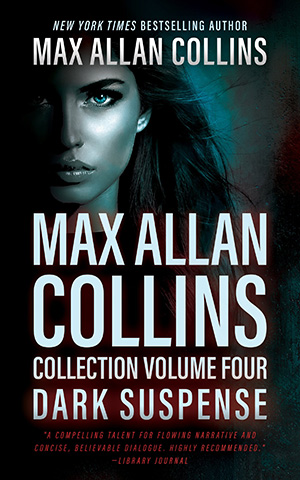
The Max Allan Collins Collection Volume Four collects Mommy, Mommy’s Day, No One Will Hear You (co-authored by Matt Clemens), and Reincarnal and Other Dark Tales. Get it here.

Reincarnal, by the way, is one of several indie movie projects we were developing (“we” being my pal Phil Dingeldein and I). Chad Bishop are starting pre-productions on Blue Christmas.

Again, these are e-book “box sets” that are at a $3.99 price point. Such a deal! (The Max Allan Collins Collection Volume One is the four Eliot Ness books, and The Max Allan Collins Collection Volume Two is the John Sand collection (the trilogy plus a short story, by Matt Clemens and me).

Now, some of you are not into e-books. You like physical media. Me, too.

Buy the hardcover Eliot Ness and the Mad Butcher by M.A.C. and Brad Schwartz here (from Daedalus Books) at a mere $6.95 (originally $29.99).

Daedalus also has the previous Nathan Heller hardcover novel, which thus far does not have a paperback reprint, Do No Harm, with Nate tackling the Sam Sheppard murder case.

* * *

Early tomorrow morning [Monday, 8/7–Nate], I am going into the hospital for a procedure that, with any luck, will get me back home the same day. So by the time this appears, I should be able to post something about how it went.

This is what’s called an ablation, which is done to deal with a-fib, which has been slowing me down since before my heart surgery in 2016.

[Update: The procedure went smoothly, and Max is back home recovering.–Nate]

* * *

Here’s an interesting Tom Hanks article, suggesting he’s the reason the violence in the film version of Road to Perdition was dialed back some.

* * *

The exciting Skydance announcement about Mike Hammer is all over the Net. Here’s an example from Deadline.

A few more (of many):
https://www.flickeringmyth.com/2023/08/skydance-bringing-mickey-spillanes-mike-hammer-back-to-the-big-screen/
https://www.thewrap.com/skydance-mike-hammer-franchise-ip-rights/
https://www.darkhorizons.com/skydance-planning-a-mike-hammer-film/
https://www.joblo.com/mike-hammer-movie-mickey-spillane/

M.A.C.

Long-Form TV, Bait Money, Paul Newman and More

Tuesday, January 5th, 2021

Skim Deep should be available by now, the coda to the Nolan series that I’ve written at the urging of Charles Ardai, the guru of Hard Case Crime. It is, as you may know if you’re a regular visitor here, a book in a series I began back in college with my novel Bait Money. That book has been reprinted with its sequel Blood Money as Two for the Money by Hard Case Crime, originally as the first book of mine HCC did, but with an uncharacteristically weak cover, though a new edition from them is coming soon.

Cover of the Skyboat audiobook edition of Bait Money
Audible: Amazon Purchase Link

An audio book – the first ever – of Bait Money is available now, read by the incredible Stefan Rudnicki.

I’m going to touch on Bait Money again, but first…

Over the holidays I found myself bingeing (usually in four-episode stints) on long-form TV. I have begun to think that long-form television is the new great storytelling art form, more satisfying than most movies and novels. When some unifying artistic force (person or persons) has an overriding vision to control and deploy, the long-form’s depth of character and ability to span time and events can give it appeal, impact and power.

Post-Christmas, I indulged in three true-crime mini-series, all of which made compelling viewing – Manhunt: Unabomber and its follow-up, Manhunt: Deadly Games; and Waco, which leaves Netflix (home of all three) in less than two weeks. I probably liked Deadly Games best, because it opened up the Richard Jewell case more completely than the Clint Eastwood-directed film was able to, and featured a fine performance by Arliss Howard as a crusty ATF bomb expert. Cameron Britton and Jack Huston (as the falsely accused Jewell and real Olympics bomber Eric Rudolph respectively) also were excellent. In Waco, Michael Shannon as the chief negotiator Gary Noesner is typically strong, but Taylor Kitsch’s turn as cult leader David Koresh is a shattering, out-of-left-field career best for the star of TV’s Friday Night Lights and the bewilderingly underrated film John Carter – he makes Koresh human and charismatic without minimizing his madness. No small feat.

All three series, however, share a common problem. They are accurate as to the core true-crime material, but play very fast and loose with fictitious material that surrounds it.

Waco places the Branch Davidian siege’s real-life negotiator at Ruby Ridge, which is not true, and goes out of its way to make the Waco cultists seem reasonable and the FBI unreasonable, when it’s fairly clear that both sides were culpable in the tragedy.

Deadly Games – faithful to the Jewell story – adds a car chase and a bunch of risible material about backwoods redneck militia guys helping track Rudolph and even being led by a young, bossy black female FBI agent; also it has the bomber murdering several people in the woods, which never happened.

The male Unabomber profiler is provided with a love-interest female profiler based on the profiler’s (second) wife, who he hadn’t met yet when the events really happened. In an even more questionable liberty, the profiler – who was largely responsible for identifying the bomber – is placed in a Silence of the Lambs relationship with the perp, sharing numerous scenes, when in fact they never met.

I have to deal with this kind of thing in the Nate Heller novels all the time – balancing the needs of the story against what really happened. It’s not easy to stay true to history without being ruled by it, which is why I employ time compression and composite characters, for example. But TV “true crime” has no compunctions about steam-rolling history.

That may be why, in part, the best long-form mini-series I watched (Barb skipped the others, but watched this one with me) is the wholly fictional The Queen’s Gambit. It’s basically a reworking of The Hustler with chess traded for pool, which is perhaps not surprising because Queen’s Gambit is taken from a novel by Walter Tevis, the author of The Hustler (on which the famous Paul Newman film was based).

Several things make the mini-series work, despite chess being something not every rube knows how to play, and that includes this Iowa rube (Barb, of course, can play chess, though does not claim mastery). The story itself works extremely well – we follow a chess-prodigy orphan girl (taught the game by the orphanage janitor) into her early teens she’s adopted by a couple who live in world out of a Douglas Sirk movie, if that movie were written by Tennessee Williams. The teen evolves into an adult as she climbs to the top of the chess world, one match at a time. The 1950s and 1960s are accurately if acidly depicted, with stellar art direction and a cunning soundtrack of popular music.

But what sells it – beyond the screenwriters and directors making chess games as compelling as any competitive sport, even for a checkers guy like me – is the stunning performance of Anya Taylor-Joy, strikingly beautiful and brilliantly understated in her role, equally convincing as a sheltered teen and worldly young woman, and the various stages between. She also credibly portrays the chess star’s descent into pills and alcohol abuse.

This gave Queen’s Gambit a special resonance to me, and here’s where Bait Money comes back in.

At the University of Iowa, from 1968 to 1970, at the Writers Workshop, I studied with the great mainstream novelist, Richard Yates. I’ve told numerous times the story of how Yates overcame his prejudice against crime/mystery fiction to recognize me as a serious-minded young writer already working at a professional level. Along the way, he became perhaps the key mentor of my writing life.

I would have been content to take all of my classes with Yates, but the program insisted on students experiencing a wider range of instructors. At the Workshop, all of the teachers were respected published authors, which was great, but problematic for a budding mystery writer in the late 1960s. To put things in context, at one point Donald E. Westlake applied for a position – well into his glorious career – and was turned down. Yup, it was a snobby, literary place. Things loosened up some, but when I was there, I was – but for Richard Yates – largely alone on my path.

I was anxious to get through the process and get on with my writing career – even though I hadn’t sold anything yet – and took summer sessions to speed things along. One summer instructor was George Cain, an African American author whose novel about drug addiction, Blueschild Baby, was highly regarded. One day he asked the entirely white class to name their favorite black authors, and the names offered up were predictable (James Baldwin, Ralph Ellison, Richard Wright). Mine were Chester Himes and Willard Motley.

Cain was astonished by these choices, almost offended, and put them both down – Himes didn’t know a thing about the real Harlem, he said, and Motley didn’t count, because he wrote about white people, which made him a sellout. At the time, I didn’t know that Himes had based his Harlem on Cleveland’s Roaring Third Precinct; so I couldn’t defend him, except to say he was a great writer. As for Motley, I said the author was probably just trying to write for a mainstream audience in the ‘40s and ‘50s, the white characters in Knock on Any Door and Let Me No Man Write My Epitaph tackling the same kind of social problems facing African Americans.

Tragically, the talented Cain – who never wrote another book – died of drug addiction himself.

I had several instructors, good ones (Cain included), who were patient with me, despite my insistence on writing crime fiction. Then, in the summer of 1970, I had the opportunity to study with Walter Tevis. I was thrilled. Overjoyed. He was the author of one of my favorite novels! The Hustler was definitely in the hardboiled school, and what a great movie had been made out of it! Obviously Tevis would not share the prejudices toward me and my work that I had sometimes suffered at the Workshop.

And he didn’t. He was a very nice man. As a teacher, he seemed a little lost, and certainly preoccupied. He was, clearly, an alcoholic. He had the sleepy, rumpled manner and bleary eyes that went with it. Often he spoke of his Hollywood experiences and I frankly don’t remember anything else about his classroom approach. Of course, we were young writers in a workshop format and the classes were primarily critique sessions, students talking about each other’s work, the instructor a kind of referee.

Black and white photograph of Walter Tevis holding a lit cigarette.
Walter Tevis. Photo credit: E. Martin Jessee/Lexington Herald-Leader

I don’t remember what fiction I submitted that summer. I know that I had completed Bait Money, and that I was continuing my private sessions with Richard Yates, who had helped me get an agent. I was probably working on No Cure for Death. Anyway – I have no memory of how Tevis reacted to any of the student manuscripts we discussed in class.

I recall vividly him speaking of being approached by a Hollywood producer to write a book or film script about poker that would mirror The Hustler. He turned the opportunity down, but said the project became The Cincinnati Kid, about which he was dismissive and resentful. I managed not to tell him that The Cincinnati Kid was a terrific movie, and the book it was based on by Richard Jessup was another favorite of mine. And that I thought he’d made a big mistake not writing a poker version of The Hustler. But now and then I know when to shut up.

Another vivid memory is Tevis being late to class by a good fifteen minutes – we almost walked out, as a group, in his absence – because he’d been on the telephone talking about a movie deal. Someone was thinking about making a film of his novel The Man Who Fell to Earth, he said.

Now, at that time he’d only written two novels. And he admitted to us that he was having trouble writing fiction at all. In fact – and I thought this was very sad at the time, and a little irritating – he put a chapter of a science-fiction book he was trying to write in front of the class, as one of that week’s manuscripts. He wanted to know what we thought about his work-in-progress. I thought we were there so he could tell us what he thought about ours.

Nonetheless, I had bonded somewhat with him, because I’d told him I was a fan, and he was astounded that I had a copy of The Man Who Fell to Earth in its original edition – a Gold Medal paperback – and that I knew The Hustler began as a Playboy short story. We worked out a trade where he gave me a signed copy of a reprint edition of Man Who Fell (from Lancer Books, a minor league company of the day), as he was short copies. I made the trade. Later I found another Gold Medal edition.

The big thing about the summer session was a one-on-one with the instructor. I believe it was a half hour, and I’d been looking forward to it. I had given Tevis the Bait Money manuscript the first day and that’s what we would be discussing. My session with him was toward the end of the summer session – it’s the last time I saw him.

He said, with my manuscript in hand, “I read the first page of your book, and I read the last page. That’s all I needed to read. You’re going to sell it.”

He handed it to me. And that was the session.

Now he may have read more than that, but at the time I was quietly furious. I was driving eighty miles round trip to attend those classes; I was paying good money to attend. And he reads two pages? Hell, in his class, I’d read a whole chapter of his damn science-fiction novel!

On the other hand, he was a pro, and a writer whose work I admired, and he’d looked at my stuff and said I was going to get published – basically, “Don’t worry about it. It’s going to happen.” And, on Christmas eve 1971, it did happen – that’s when the letter came from my agent.

And I do think he may actually have read my whole book. Because his inscription on my signed copy of The Man Who Fell to Earth was: “To Allan – with great hopes for his good book. Walter, July 1970.”

So I had mixed feelings about Walter Tevis. I thought he was a nice, melancholy man with a drinking problem. I always bought his books, including three more science-fiction titles, the first of which didn’t appear till almost a decade later (Mockingbird). Alcoholics Anonymous had been a factor in an early ‘80s comeback, when in a period of about five years he wrote four of his six published novels.

I bought and read the last of these – his unexpected Hustler sequel, The Color of Money, and loved it. Read it in two sittings. I wrote him a letter telling him so, and reminiscing about my experiences as his student, going over much of what I’ve written here, being frank but also appreciative.

I had a stamp on the envelope and the letter was waiting to be mailed when a newspaper told me that Walter Tevis had died. Lung cancer. He’d struggled with a heart condition as well.

My instructor’s novel, The Queen’s Gambit, is – like so many novels by so many of us – a disguised memoir, chess champ Beth Harmon enjoying early success, succumbing to substance abuse, overcoming it, and making a stellar comeback.

As with Skim Deep to Bait Money, there’s a coda to my Walter Tevis story.

Whenever I meet someone famous, I endeavor to find some way I can connect with that person, as a person. With Tom Hanks, at the Chicago Road to Perdition after party, I talked to him about his directorial debut, That Thing You Do, and my having been in a combo much like the one in his film, opening for ‘60s era bands and so on. He lit up. We connected, however briefly.

I took a similar tack meeting Paul Newman at the New York Perdition premiere after party. I should say that of the famous people I’ve met, he was the most intimidating, with the most impenetrable wall up – not unpleasant or nasty in any way, but…he just seemed like a door that had been knocked on too often.

So I mentioned that I studied at the Writers Workshop with the author of The Hustler.

“We threw the whole book out,” Newman said. “Nothing made it into the film. We didn’t use anything.”

Now, I knew this not to be true. The film is a fairly faithful adaptation. So I was flustered. I said something like, “Well, I liked them both very much.”

We spoke a little bit longer, but I was really thrown. Was he sending me a coded message about how unimportant the source writer (me) was to a film like Road to Perdition? Nonetheless, I told him how honored I was to be part of a project of his, and that seemed to please him. We shook hands.

Much later I figured it out. Or anyway I think I did. Newman also starred in The Color of Money (1986), supposedly based on the Tevis sequel to The Hustler. And in that case, the novel really was thrown out, because the Tevis book had a lot to do with the return of Minnesota Fats.

The film version substituted a young pool player, portrayed by Tom Cruise, and the word in the Hollywood trades was that Newman didn’t like working with Jackie Gleason (nominated for an Academy Award for his portrayal of Minnesota Fats), and wouldn’t do the sequel with him in it. And Gleason was too associated with the role to recast, so a new story was written to go with the title of the Tevis book.

The press said Newman claimed he wanted Gleason in as a cameo, and Gleason said he passed after reading scripts that included small scenes with the character that he didn’t feel added to the story. On the other hand, Tevis apparently wrote a faithful adaptation of his book that included Fats as a key player in several senses of the word. The Tevis script was rejected.

In any event, I didn’t care for the film of The Color of Money. It seemed to pander after a young audience via Tom Cruise, and was not one of director Martin Scorcese’s best pictures, and is little talked of today. If you can find the novel, give that a read – it’s very good.

But I have to wonder about that book – did Newman even read the first and last page?

* * *

Here’s a lovely Skim Deep review by Ron Fortier.

Somebody has just discovered the Quarry TV show and likes it.

I made Today’s Word! [I had trouble getting a good link to this (for the time being, it should be the first result at the link above), but I think the newspaper got this from this page at Wordsmith, with some good comments too. — Nate]

Finally, that great podcast Paperback Warrior considers Killing Quarry one of the best ten books the co-host read in 2020.

M.A.C.